In the world of card games, poker has always represented a balance between skill, strategy, and luck. But as casinos and gaming environments become increasingly digital, even the classic poker table is being transformed by technology. One innovation leading this transformation is the RFID poker card — a smart playing card embedded with microchip technology that’s redefining how games are played, tracked, and secured. While traditional poker cards have served players well for centuries, RFID-enabled cards offer a new level of precision, transparency, and security. This article explores the key differences between traditional poker cards and RFID poker cards, highlighting how this technology is shaping the future of gaming.
1. What Is an RFID Poker Card?

An RFID poker card takes the familiar playing card concept and upgrades it with modern technology. RFID stands for Radio Frequency Identification, a technology that uses electromagnetic fields to automatically identify and track tags attached to objects. In the case of an RFID poker card, a tiny RFID chip and antenna are embedded inside each card. These chips store a unique identification code that can be read by RFID readers integrated into the poker table or surrounding equipment. Every time a card is dealt, moved, or revealed, the reader detects and logs that action in real-time.
Here’s how it works:
- Each card in the deck is assigned a unique digital ID.
- The RFID reader embedded in the table detects which card is in play or in a specific position.
- The system transmits this data to a central server or software interface, which can display, analyze, and record the game’s progress instantly.
This level of automation allows casinos and gaming operators to track every hand, detect irregularities, and ensure complete transparency throughout the game.
2. Key Differences Between RFID and Traditional Poker Cards
To better understand the impact of RFID technology, let’s break down the major differences between traditional poker cards and RFID poker cards:
| Feature | Traditional Poker Card | RFID Poker Card |
| Material | Paper or plastic | Multi-layer laminate with embedded RFID chip |
| Functionality | Manual dealing and tracking | Automatic tracking through RFID readers |
| Security | Vulnerable to cheating or marking | Encrypted, traceable, and tamper-resistant |
| Durability | Easily worn or damaged | Longer lifespan, moisture-resistant |
| Cost | Low-cost, disposable | Higher cost, long-term investment |
| Applications | Home games, casual play | Casinos, tournaments, smart tables |
The most salient difference lies in functionality and security. A traditional card is a passive object; its value is purely visual. An RFID card is an active data source, constantly communicating its identity. This shift from passive to active is the core of the revolution.
3. Advantages of RFID Poker Cards
The integration of RFID technology into poker cards offers a suite of advantages that are simply unattainable with traditional decks. These benefits are particularly crucial in high-stakes or broadcasted environments where integrity and transparency are paramount.

3.1 Anti-Cheating Technology
The most compelling argument for the adoption of RFID technology is its unparalleled ability to combat cheating. In traditional games, players can attempt to mark cards, introduce foreign cards, or collude with the dealer. With RFID, every single card is tracked in real-time from the moment it leaves the deck to the moment it is mucked.
- Instant Verification: The system knows exactly which cards are in the deck, which are in the burn pile, which are on the board, and which are in each player’s hand. Any discrepancy—such as a card appearing that shouldn’t be in play, or a card being swapped—triggers an immediate security alert.
- Unique Digital ID: Because each card has a unique, unchangeable digital identifier, it is practically impossible to substitute a card from another deck or use a counterfeit. The system verifies the card’s identity, not just its face value.
3.2 Game Automation and Efficiency
RFID technology streamlines the game process, leading to faster, more efficient play, which is a significant factor in professional settings.
- Automatic Tracking: Smart tables equipped with RFID readers can automatically log the entire game history. This eliminates human error in recording hands, pot sizes, and betting actions.
- Broadcast Integration: For televised or live-streamed poker, the RFID system is indispensable. It instantly feeds the card information to the broadcast graphics team, allowing viewers to see the players’ hole cards without compromising the integrity of the live game. This feature has become a cornerstone of modern poker entertainment.
3.3 Data Insights and Fairness
The data generated by the RFID system is a goldmine for both operators and players.
- Statistical Analysis: Casinos and tournament organizers can collect vast amounts of data on game speed, dealer efficiency, and player performance. This data can be used to optimize operations, improve fairness, and tailor the player experience.
- Security Audit Trail: In the event of a dispute or suspicion of foul play, the system provides an irrefutable, time-stamped log of every card’s movement. This audit trail ensures the highest level of transparency and trust.
3.4 Enhanced Durability and Longevity
An RFID poker card is more robust than a traditional one. Constructed with multiple layers and a sealed chip, it resists moisture, bending, and general wear. This durability makes it ideal for high-traffic casinos where decks are frequently used. While the initial cost is higher, RFID cards last significantly longer, offering better long-term value.
4. Are RFID Poker Cards Worth It?
The question of whether to adopt RFID technology ultimately boils down to a cost-benefit analysis, which is heavily influenced by the environment in which the cards are used.
For casual home games or low-stakes environments, the high initial cost of RFID poker card decks and the necessary smart table infrastructure is prohibitive and unnecessary. Traditional cards, with their low cost and ease of use, remain the undisputed champion in this sector. However, for casinos, the investment quickly pays off. The enhanced security prevents losses from cheating, the data analytics improve management, and the reduced need for manual oversight saves labor costs. In addition, RFID poker cards help build trust among players, as the system ensures complete transparency in every game.
5. Conclusion
While traditional poker cards will always hold nostalgic value for players, the RFID poker card is redefining what’s possible at the poker table. The RFID poker card represents a major step toward the concept of the smart casino — an environment where every card, chip, and table is interconnected. As technologies like AI, machine learning, and IoT (Internet of Things) integrate with RFID systems, the gaming industry will see even more automation, personalized experiences, and advanced security protocols.
FAQs
1. Do RFID poker cards require special tables?
Yes. RFID poker cards need RFID-enabled tables with built-in antennas and readers to detect and track the cards. These tables are often connected to casino management systems or live broadcast software.
2. Can RFID poker cards be hacked or cloned?
No, reputable RFID poker cards use encrypted chip data that prevents cloning or tampering. Each card has a unique, securely encoded ID that cannot be duplicated without detection, ensuring game integrity and security.
3. Can RFID poker cards be used in regular home games?
Technically yes, but RFID poker cards are designed for professional environments. They require RFID readers and compatible software to function properly. For casual home games, traditional cards are more practical and cost-effective.
Recommended Product
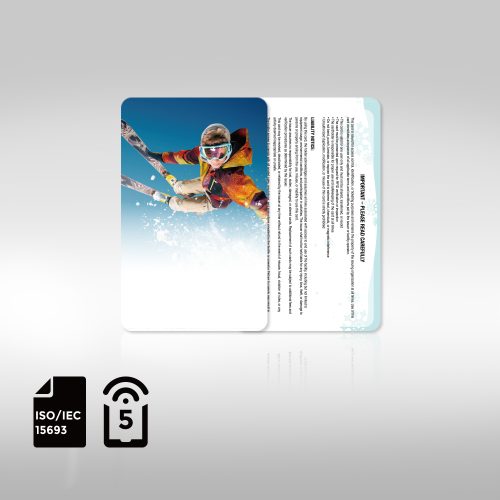
RFID Ski Pass Card NXP ICODE® SLIX2

The NXP ICODE® SLIX2 RFID Ski Pass Card is a high-performance HF smart card designed for ski resorts, mountain attractions, and outdoor access applications. Embedded with the NXP ICODE® SLIX2 chip, this card operates at 13.56 MHz and complies with ISO/IEC 15693 and NFC Forum Type 5 standards, providing reliable contactless identification and fast access validation. With long read range capability, anti-collision support, and sufficient user memory, it is suitable for lift access control, season passes, guest identification, and resort ticketing systems.