With the continuous advancement of digital transformation, campus management is heading towards a smarter and more efficient direction. In this process, RFID technology, as a revolutionary innovation, is gradually penetrating all facets of campus life, especially in student identity recognition and campus management systems. RFID technology not only enhances the operational efficiency of the campus but also offers students and faculty a more convenient and secure identity verification experience.
The concept of a smart campus has long transcended the traditional teaching environment. It signifies a new educational ecosystem that integrates smart hardware, network systems, and data analysis technologies to create a safer and more efficient learning and working environment for both teachers and students. RFID technology, as a key infrastructure of smart campuses, supports seamless campus management—enabling student identity authentication, access control, consumer payments, and library borrowing and returns through smarter solutions.
In this context, RFID campus cards, as one of the core components of the smart campus system, play an increasingly crucial role. This RFID-enabled campus card significantly improves campus management efficiency, enhances identity authentication for students and faculty, bolsters campus security, and advances the institution’s modern management level.
This article will explore how to utilize NXP ICODE® SLIX2 RFID card technology to achieve seamless student identification and promote the comprehensive development of smart campuses. By integrating the advanced technology of NXP ICODE® SLIX2, we will showcase its various applications within smart campuses and examine the future trends it may usher in.

Application of RFID Technology in Smart Campus
Overview of RFID Technology
RFID (Radio Frequency Identification) technology is an automatic identification method that transmits and identifies data through radio waves. It facilitates the exchange of information between a reader and a tag using radio frequency signals and is widely used in logistics, supply chain management, identity recognition, and other fields. In the campus setting, the application of RFID is bringing revolutionary changes to the education sector.
Basic Principles and Working Mechanisms: RFID technology relies on wireless radio frequency signals and typically consists of three components: tags, readers, and antennas. The tag contains a microchip that stores unique identification information. When the tag comes close to the reader, the reader transmits a radio frequency signal to communicate with the tag. The tag responds to or reflects the signal to transmit its information, thus completing the data exchange. Unlike traditional technologies like barcodes, RFID does not require direct contact or alignment with the device, offering higher reading efficiency and accuracy.
Main Components of RFID
Tag: A chip and antenna that contains stored information, categorized as active tags and passive tags. Active tags have their own batteries and can actively transmit signals, while passive tags rely on the signal energy provided by the reader.
Reader: Responsible for communicating with the tag, reading the tag data, and transmitting it to the background system.
Antenna: Used to send and receive radio frequency signals to facilitate remote communication between the tag and the reader.
Application Scenarios of RFID in Campus Management
RFID technology has a broad range of application scenarios in campus management, improving the efficiency of identity authentication for students, faculty, and staff; simplifying management processes; and enhancing campus security. Here are the main applications of RFID technology in smart campuses:
Student Identity Authentication
RFID cards serve as student ID cards, providing a convenient and quick way to authenticate identity. Students just need to bring the card close to the reader without any manual operation, allowing the system to automatically recognize their identity. This seamless method significantly increases convenience for students on campus. Whether entering classrooms, participating in campus events, or borrowing books, identity verification can be done through RFID cards, ensuring both efficiency and security in campus management.
Access Control
RFID technology is widely employed in campus access control systems. By utilizing RFID cards, schools can set up different permissions to control who can enter designated areas. The RFID access control system ensures that only authorized personnel can access critical areas such as teaching buildings, laboratories, and dormitories through automatic identification, enhancing campus security management and preventing unauthorized access. Compared to traditional key or password systems, RFID access control improves security and simplifies the operational process.
Library Management
The application of RFID technology in library management makes book borrowing and returning more efficient and convenient. By equipping books with RFID tags, libraries can automate the borrowing, returning, and inventory processes. When students arrive at the checkout desk with RFID-tagged books, the reader can automatically identify the book information and complete the borrowing operation, reducing manual errors and wait times at queues. Meanwhile, the management of library books becomes more efficient, allowing staff to quickly conduct inventory through the RFID system, thereby reducing loss rates and management costs.
Payment System
The campus card system represents one of the most typical applications of RFID technology on campus. By using RFID cards as payment tools, students can make transactions easily at campus locations like cafeterias, supermarkets, and printing centers. Students only need to gently bring the RFID card close to the card reader, eliminating the need for cash or bank cards, making the payment process quick and convenient. Simultaneously, the school can track consumption data through RFID cards, providing detailed spending accounts, which simplifies fund management for both students and the institution.
Attendance System
RFID technology can facilitate an automated attendance system. Students only need to swipe their cards, and the system automatically logs their arrival time and attendance, preventing human errors seen in traditional manual record keeping. The RFID attendance system not only boosts efficiency but also enables real-time monitoring of students’ attendance status, providing accurate data support for teachers and administrators. Additionally, the RFID-powered attendance system automatically detects whether students have entered the classroom, ensuring it records attendance even if students forget to sign in or arrive late.

NXP ICODE® SLIX2 Technical Analysis
Introduction to NXP ICODE® SLIX2
NXP Semiconductors is one of the world’s leading semiconductor companies, with extensive technological expertise and market leadership in the field of RFID technology. The NXP ICODE® SLIX2 series chips are high-performance and efficient RFID products specifically designed for Internet of Things (IoT) and smart application scenarios, particularly in smart campuses, logistics management, asset tracking, and library management.
The ICODE® SLIX2 chip operates at a frequency of 13.56 MHz and adheres to the ISO/IEC 15693 international standard, making it suitable for long-range near-field communication. It’s widely used for high-density and high-efficiency identity recognition and data management. With its outstanding performance, ICODE® SLIX2 finds various applications across RFID systems, delivering seamless identity authentication, data storage, and item tracking services.
Technical Advantages of NXP ICODE® SLIX2
High Performance: Supports Fast and Seamless Identity Recognition
ICODE® SLIX2 can complete identity recognition in milliseconds, greatly enhancing authentication efficiency and avoiding the queuing and waiting issues present in traditional identity recognition methods. This high performance suits high-traffic scenarios in campus environments, such as library borrowing, attendance check-ins, and access control systems, ensuring a smooth experience for students and faculty in various situations.
Robust Data Storage Capacity: Provides Ample Storage Space
With 2560 bits of user memory, the ICODE® SLIX2 can store a wide array of data, including student names, student IDs, course schedules, and attendance information. This makes it very suitable for use as an ID card in smart campuses, enabling not only basic identity authentication but also supporting more personalized services. Such data storage capacity is beneficial for multifunctional applications within smart campus management systems, such as personalized campus services and participation records for on-campus activities, further enhancing the intelligence and personalization of campus systems.
Long Reading Distance: Enhances Card Reading Efficiency
ICODE® SLIX2’s long reading distance (up to 1.5 meters) allows it to offer a wider recognition range. For instance, in access control systems, students only need to gently bring the card close to the reader to complete identity authentication, minimizing the need for frequent contact with the device, which greatly improves usability. The advantage of a long reading distance also makes this technology suitable for large-scale campus environments, facilitating efficient identification at multiple entry and exit points as well as attendance areas, thus reducing queuing and waiting times.
Strong Anti-Interference Capability: Adapts to Various Environmental Conditions
ICODE® SLIX2 features strong anti-interference capabilities and can operate stably in complex electromagnetic environments, ensuring that the system can accurately and swiftly identify cards even in high-density student flow scenarios. Whether in classrooms, dormitories, or sports fields, ICODE® SLIX2 ensures stable data transmission and prevents recognition failures caused by signal interference.

Seamless Student Identification with RFID Cards for Smart Campuses
Seamless identification refers to an authentication process that is fast, accurate, and requires minimal user intervention. In a smart campus environment, RFID technology enhances the efficiency and smoothness of student identification. As an advanced RFID technology product, the NXP ICODE® SLIX2 RFID card showcases several distinct advantages in student identification, making the smart campus system more effective, precise, and user-friendly.
Fast Reading
When using the NXP ICODE® SLIX2 RFID card, students do not need to remain in the identification area or perform any manual operations; the system can automatically read their information. This automated process greatly improves the speed of identity authentication, particularly in high-traffic campus environments. For instance, when borrowing books from the library, paying at the cafeteria, or entering the gate, students only need to approach the identification device, and the system can swiftly complete identity verification and authorization.
High-Precision Verification
RFID cards provide high-precision verification, decreasing the likelihood of identification errors due to their robust anti-interference capabilities and stable data transmission. In traditional barcode or QR code systems, users may be unable to obtain a reading due to damaged barcodes or blurred QR codes. However, RFID cards communicate data using wireless radio frequencies, significantly reducing such issues. Moreover, the encryption and authentication features of NXP ICODE® SLIX2 effectively mitigate identity forgery and fraud, ensuring the security and reliability of the system.
Convenient Experience
The convenience of using RFID cards stands out as one of its biggest advantages. In contrast to traditional identity verification methods, RFID technology simplifies user operations. Students don’t need to manually enter passwords or swipe cards; they merely bring the card close to the reader or sensor, and the system automatically recognizes their identity and completes the operation. This non-intrusive recognition method enhances the student experience, reduces waiting and operational time, and improves the overall efficiency of the system.
Technical Implementation and Operation Process
In smart campuses, the application of NXP ICODE® SLIX2 RFID cards extends beyond identity verification. They are widely used across multiple systems and scenarios, achieving seamless student identity recognition through technological integration.
Students leverage NXP ICODE® SLIX2 RFID cards to access various application scenarios such as access control, library management, and payment systems:
Access Control: Students simply need to bring their campus cards with NXP ICODE® SLIX2 chips close to the access control reader. The system will automatically verify their identity and unlock access according to their permissions. Whether it’s for a teaching building, dormitory, or laboratory, the RFID access control system ensures safe and efficient management.
Library Management: RFID cards are utilized to recognize both students and books. Students can use a self-service borrowing machine or visit the library service desk where the RFID system will identify their identity and automatically update borrowing records. This operation requires no manual intervention, alleviating the burden of manual management.
Payment System: Students can use RFID campus cards to make payments at cafeterias, supermarkets, or printing centers. By bringing the RFID card close to the payment terminal, students can quickly complete their transactions, avoiding the cumbersome processes associated with traditional cash payments or card swiping.
The System Automatically Reads Information and Quickly Completes Identity Verification
In every application scenario, the reading time for the NXP ICODE® SLIX2 RFID card is extremely short. Almost as soon as the student approaches the card reader, the system can automatically identify the card information and complete the identity verification. At various access control points on campus, library lending areas, and payment terminals, the system quickly recognizes and processes the student’s identity information, ensuring a seamless and nearly imperceptible identity verification process for the student.

Security and Privacy Protection of Smart Campus RFID System
Security Challenges of RFID System
With the widespread application of RFID technology in smart campuses, while it has brought convenience and efficiency, it also faces several potential security risks. Particularly concerning sensitive data such as student identities, payment information, and campus resource management, the security and privacy protection of RFID systems are especially critical.
Potential Security Risks Faced by RFID Technology
Data Theft: RFID tags use wireless radio frequency technology for data transmission, making it possible for unauthorized third parties to intercept data during transmission. If data is stolen, it could lead to the leak of sensitive information such as student identities and payment details.
Forged Cards: Attackers may forge RFID cards, posing as students to gain access to restricted areas or make unauthorized payments, leading to fraud and other malicious activities. This poses a threat to campus security and financial management.
Possible Security Vulnerabilities
Unencrypted Data Transmission: If the RFID system does not encrypt data during transmission, attackers can easily monitor or tamper with sensitive information, leading to information leaks or identity forgery.
Unprotected Storage Method: If the system does not encrypt or effectively protect student information stored in the RFID card, someone may illegally read or modify it, increasing the risk of data leakage and misuse.
Security Technology of NXP ICODE® SLIX2
The NXP ICODE® SLIX2 RFID chip integrates a variety of advanced security technologies, providing robust protective measures to ensure the security of data transmission and the protection of students’ privacy. Here are the main security features of NXP ICODE® SLIX2:
Unique Identifier (UID)
Each NXP ICODE® SLIX2 chip has a unique device identifier (UID) (8 bytes), ensuring that each RFID card has unique identification information to prevent counterfeiting and unauthorized use.
Originality Signature
The chip includes a 32-byte originality signature that verifies its authenticity. This mechanism effectively protects the chip from cloning or counterfeiting, enhancing system security.
Write Protection Mechanism
NXP ICODE® SLIX2 has a built-in locking mechanism that can write-protect each user memory block. This means that authorization controls writing or modifying data, preventing unauthorized tampering.
Locking Mechanism
In addition to write protection, the chip has a locking mechanism that can protect the DSFID, AFI, and EAS functions. Locking these functions ensures that malicious modifications or disabling cannot occur, enhancing the overall security of the chip.
Password Protection
NXP ICODE® SLIX2 chips provide a 32-bit password protection function for managing read and write access to memory. The system allows access to or modification of data on the chip only if the correct password is entered, thereby preventing unauthorized access.
Password-Protected Read Access: It restricts card data access to only authorized users.
Password-Protected Write Access: Ensures that only legitimate authorized users can modify chip memory to prevent data tampering.
Tag Destruction Protection
The password protection function prevents illegal destruction or reconfiguration of the tag by allowing data to be destroyed only after entering the correct password.
Password Protection for EAS and AFI Functions
Password protection can secure Electronic Article Surveillance (EAS) and Application Function Identifier (AFI), ensuring that only authorized personnel can enable or modify these security features, thereby increasing the system’s protection level.
16-Bit Counter (Optional Password Protection)
NXP ICODE® SLIX2 is also equipped with a 16-bit counter that can be used as an anti-tampering measure. The counter increments with each read and write operation of the card to help detect unauthorized activities. If the counter’s value is tampered with, an alarm will be triggered. Furthermore, the counter can also be set for password protection to enhance data security.
Through these multi-layered security technologies, the NXP ICODE® SLIX2 chip provides high-intensity protection to ensure the security and privacy of the smart campus RFID system.
Security Management Measures for Smart Campus RFID Systems
In addition to utilizing the security features provided by the NXP ICODE® SLIX2 chip itself, schools should implement a series of security management measures to further enhance the security of their RFID systems. These measures include:
Regularly Updating System Software and Patching Vulnerabilities
Security threats are constantly evolving, making it essential to regularly update system software and install security patches. By fixing potential vulnerabilities, the risk of attacks on the RFID system can be reduced, ensuring that student information is consistently protected.
Implementing Multiple Authentication Mechanisms, Combining Biometrics and Password Protection
Beyond RFID card authentication, schools should also adopt multiple authentication mechanisms such as biometrics (fingerprint, facial recognition) and password protection. These measures ensure that only authorized personnel can access campus resources, further enhancing campus security.
By combining the security features of the NXP ICODE® SLIX2 chip with multiple protective measures in campus management, schools can guarantee the security of their RFID systems, preventing the leakage of student personal information and defending against system attacks.

Future Development Trends of Smart Campus RFID Systems
With the continuous advancement of science and technology, smart campus RFID systems are also evolving and developing. In the future, RFID technology will extend beyond simple identity authentication and will advance in a direction that is more intelligent, efficient, and secure. Below are some future development trends of smart campus RFID systems.
Advances and Innovations in RFID Technology
Innovations in New Generation RFID Technology
With the ongoing advancements in RFID technology, the new generation of RFID innovations will further enhance system efficiency and user experience. RFID tags with higher frequencies, longer ranges, and greater precision will be developed to support faster identity authentication and resource management. For example, the application of UHF (ultra-high frequency) RFID tags will enable a wider reading range for campus systems, allowing users to complete identity authentication or payment without needing to remain in a specific area for extended periods. Additionally, RFID chips will further optimize their power consumption, improve energy efficiency, and extend equipment lifespan.
Integration of the Internet of Things (IoT) and RFID
The combination of RFID technology and IoT will propel the development of smart campuses to a deeper level. By linking RFID tags with various smart devices (such as sensors, smart locks, and smart cameras), objects and equipment on campus will be able to interconnect in real time, forming a large-scale smart ecosystem. For instance, RFID tags can help monitor the usage of campus facilities, student flow, and the consumption of various resources, providing more accurate data support for campus management.
Comprehensive Digitalization of Smart Campuses
Integration of Hardware and Software in Future Campuses
Future smart campuses will rely not only on RFID cards but will also incorporate more intelligent hardware and software applications. For example, RFID cards may connect with multiple functional modules such as smart access control systems, automated attendance systems, and digital course management platforms to achieve comprehensive digital management. Students, teachers, and other staff can obtain personalized services through unified smart terminal devices, leading to a more efficient and convenient campus experience.
Big Data Analysis Based on RFID Technology
As RFID systems become more widespread, vast amounts of campus data will be collected and stored. Schools can utilize big data analytics to help decision-makers gain in-depth insights into student behavior, resource allocation, campus safety, and more. Through data analysis, schools can optimize resource allocation in real time, improve management efficiency, and even predict safety risks or changing trends in student needs. Additionally, the data collected by RFID systems can provide critical decision-making support for teaching, research, and other areas.
Environmental Protection and Sustainable Development
Combination of RFID Technology and Green Campus Initiatives
With increasing environmental awareness, the application of RFID technology in smart campuses will also converge with green environmental protection concepts. The proliferation of RFID technology can effectively reduce the use of traditional paper materials. For instance, in library management, traditional paper borrowing records can be replaced by RFID tags, thereby reducing paper consumption; in course management, electronic sign-ins and class schedule inquiries can further reduce paper waste. Moreover, RFID can be utilized in on-campus waste sorting and recycling efforts to foster the establishment of green campuses.
More Environmentally Friendly Card Materials and Technical Applications
With the promotion of sustainable development concepts, future RFID campus cards will utilize more eco-friendly materials. In addition to traditional plastic cards, an increasing number of RFID cards will feature degradable or recyclable materials to lessen environmental burdens. Furthermore, RFID technology itself is also shifting towards lower power consumption and higher efficiency, further decreasing energy usage and the carbon footprint associated with electronic devices.

Conclusion: Promoting the Application of RFID Technology in Smart Campuses
In the construction of smart campuses, NXP ICODE® SLIX2 RFID technology perfectly addresses the needs of identity recognition, payment, resource management, and more, with its high efficiency, accuracy, and security. Through seamless identity authentication and intelligent campus services, RFID technology significantly improves the user experience for students, teachers, and administrators while enhancing the efficiency and security of campus management.
Looking ahead, RFID technology is set to facilitate the realization of more smart campuses worldwide. With continuous technological innovations, RFID will expand beyond basic identity authentication and become a core component of the smart campus ecosystem, providing students and educators with a more convenient and efficient experience.
Therefore, schools and educational institutions should actively invest in RFID technology to promote the digital transformation of campuses, boost management efficiency and security, thereby creating a smarter and more convenient learning environment for students and ensuring the ongoing innovation and development of campuses.

FAQs
What are the potential application scenarios of RFID technology in smart campuses?
RFID technology has numerous potential application scenarios in smart campuses, including:
Smart Classroom Management: Automatically identify students in the classroom through RFID technology, conduct attendance tracking, and even provide personalized learning resources.
Campus Security Management: Combine RFID with video surveillance systems to track the location of students and staff in real-time, thereby enhancing campus safety.
Automated Library Management: Utilize RFID tags to automate book borrowing and returning processes, reducing manual operations and improving efficiency.
Item Tracking: Track high-value equipment on campus, such as computers and laboratory equipment, using RFID tags to minimize loss risks.
In what aspects does the RFID campus card perform better than traditional student cards?
RFID campus cards offer the following advantages over traditional barcode or magnetic stripe student cards:
Higher Reading Speed: RFID cards do not need to make contact with the card reader, allowing students to quickly pass through access control systems or borrow and return books, significantly improving efficiency.
Longer Lifespan: RFID cards are less prone to damage as they do not rely on physical card swiping, making them suitable for long-term use.
Enhanced Security: RFID cards can store data in an encrypted form and can prevent copying or tampering through technologies such as password protection and data encryption.
Multi-functional Integration: RFID campus cards can integrate various functions, including identity recognition, payment, access control, and book borrowing, achieving “one-card” management and reducing the number of cards students need to carry.
How to ensure data security and privacy protection of RFID campus cards?
To ensure the data security and privacy protection of RFID campus cards, the following measures can be taken:
Encrypted Transmission: Data transmitted between RFID cards and readers should be encrypted to prevent interception during transmission.
Password Protection: RFID cards can implement password protection mechanisms to restrict unauthorized access to card data and prevent illegal reading.
Privacy Mode: RFID cards can have a privacy mode that allows only necessary identity information to be exposed when required, safeguarding students’ personal privacy.
Anti-Tampering Design: RFID chips like the NXP ICODE® SLIX2 have built-in anti-tampering mechanisms to ensure that the data stored on the chip cannot be modified without authorization.
How RFID Technology Can Be Combined with Campus Payment Systems to Improve Convenience and Security?
The integration of RFID technology with campus payment systems can lead to the following benefits:
Contactless Payment: Students need only to bring their RFID campus card close to the payment terminal to complete transactions, avoiding the hassle of entering passwords or using cash.
Enhanced Security: The RFID payment system ensures transaction data security through encryption technology, protecting payment information from theft.
Unified Management: RFID cards can integrate various payment functions on campus, such as canteen consumption, printing services, and dormitory fees, allowing students to manage multiple accounts conveniently with a single card.
Real-Time Balance Inquiry: Students can check their balance at any time through RFID cards and have the option for automatic top-ups to prevent being unable to pay due to insufficient funds.
What are the advantages of using RFID campus cards in the attendance system?
The application of RFID technology in attendance systems has the following advantages:
Automation and Efficiency: With RFID cards, students do not need to manually sign in, as the attendance system automatically records their entry and exit times, enhancing attendance efficiency.
Real-Time Data Synchronization: The RFID attendance system can update attendance data in real time, allowing administrators to check attendance at any moment and reducing manual errors associated with traditional attendance methods.
Reduction of Cheating Possibilities: The RFID attendance system helps minimize cheating behaviors, such as one student signing on behalf of another, since the card must be physically present for verification, ensuring the authenticity of attendance records.
Data Integration: The RFID attendance system can integrate with other smart campus systems (such as student behavior management systems and academic monitoring systems) to provide schools with a more comprehensive view of student management.
Recommended Products
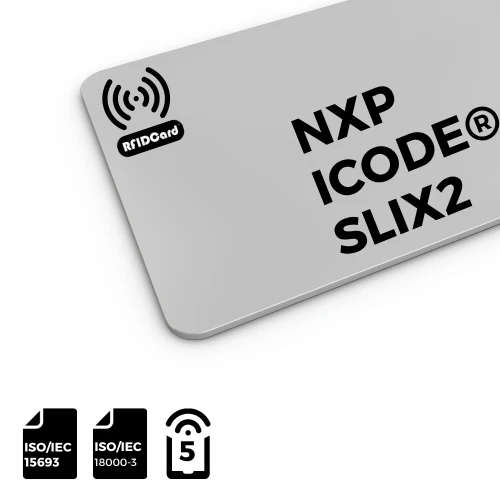
RFID/NFC Card NXP ICODE® SLIX2

Blank or customized printing RFID card with choice of dimensions available. The ICODE® SLIX2 IC is fully compatible with ICODE® SLIX and offers larger user memory. ICODE® SLIX2 is also defined as NFC Forum Type 5 Tag IC.