As RFID technology becomes deeply integrated into modern life the question of security has become unavoidable. At the heart of this security challenge lies RFID chip encryption, a critical mechanism that determines whether RFID systems are resilient against cloning, unauthorized access, and data breaches.
1. Understanding RFID Chip Security vs Encryption
To navigate the world of RFID, one must first distinguish between general security measures and actual encryption. While the terms are often used interchangeably, they represent different layers of protection within the chip’s architecture.

1.1 What Is RFID Chip Encryption?
RFID chip encryption refers to cryptographic mechanisms embedded in RFID chips to protect data and control access. These mechanisms ensure that only authorized readers or systems can authenticate with the chip, read its memory, or modify its data.
It is crucial to differentiate between several common security features:
- UID (Unique Identifier): A serial number hardcoded by the manufacturer. While unique, it is not encrypted and can be easily “sniffed” or cloned.
- Authentication: The process by which the tag and the reader verify each other’s identity before exchanging data.
- Encrypted Memory: Specific sectors of the chip’s memory that require a successful authentication and a valid key to access.
1.2 Security Layers in RFID Chips
A truly secure RFID system employs multiple layers of defense:
- UID: Serves as the basic “name” of the tag.
- Memory Access Control: Logic gates that prevent reading or writing to certain blocks without permission.
- Authentication Mechanisms: Challenges and responses that prove the reader is legitimate.
- Cryptographic Encryption: The “gold standard” where the actual data payload is scrambled using algorithms like AES or ECC.
2. Basic RFID Chip Security (Low-Level Protection)
Not every application requires high-level military-grade security. For low-risk environments, basic security measures are often sufficient and cost-effective.

2.1 UID-Based Identification (No Real Encryption)
The most basic level of RFID security relies solely on the UID. Many low-frequency (LF) and some high-frequency (HF) chips operate this way.
- Typical Chips: EM4100, TK4100, and many generic LF tags.
- Advantages: Extremely low cost and high compatibility.
- Limitations: Highly vulnerable to cloning.
2.2 Password-Protected RFID Chips
A step above UID-based systems is password protection. Some RFID chips allow users to set passwords to restrict read or write access to memory blocks.
- Typical Chips: NXP NTAG21x series, ICODE SLIX2.
- Use Cases: Smart marketing, product authentication for retail, and simple access control for low-security areas like gym lockers.
3. Intermediate RFID Chip Encryption (Standard Security)
As we move into corporate environments and public transit, the need for robust protection becomes paramount. This is where true cryptographic algorithms enter the fray.

3.1 Proprietary Cryptography
In the early days of secure RFID, manufacturers developed their own “secret” algorithms. The most famous example is MIFARE Classic, which uses a proprietary 48-bit encryption called Crypto-1.
- How it Works: It uses a stream cipher to encrypt the communication between the card and the reader.
- Known Vulnerabilities: Crypto-1 was famously cracked in 2008. Today, MIFARE Classic is considered “insecure” for high-stakes applications, though it remains widely used in legacy systems due to its low cost.
3.2 Symmetric Key Encryption (DES / 3DES)
To address the limitations of proprietary encryption, many RFID systems adopted standardized cryptographic algorithms such as DES (Data Encryption Standard) and 3DES (Triple DES).
These algorithms use symmetric keys, meaning the same key is shared between the chip and the reader. They provide stronger security than proprietary methods and are used in various RFID applications.
- Use Cases: Legacy public transportation systems and older corporate ID badges.
3.3 AES-Based Encryption (Standard Modern Security)
The Advanced Encryption Standard (AES) is currently the global benchmark for RFID chip encryption. It is a symmetric-key algorithm that is virtually uncrackable by modern computing standards when implemented correctly.
- Typical Chips: MIFARE DESFire EV1, EV2, and EV3.
- Key Features:
- Mutual Authentication: Both the card and the reader must prove their identity to each other.
- Secure Messaging: Every single packet of data sent over the air is encrypted.
- Encrypted Storage: Data on the chip is stored in an encrypted state, protected by AES-128 or AES-256 keys.
4. Advanced RFID Chip Encryption (High-Security Solutions)
For government IDs, electronic passports, and high-value payment systems, even standard AES is sometimes supplemented with more advanced mathematical frameworks.

4.1 Advanced Cryptographic Algorithms
Modern high-security chips often utilize Asymmetric Encryption, also known as Public Key Infrastructure (PKI).
- Elliptic Curve Cryptography (ECC): ECC provides the same level of security as traditional RSA but with much smaller key sizes, making it ideal for the limited processing power of an RFID chip.
- PKI: This allows for digital signatures, where a chip can prove its authenticity without ever revealing its private key to the reader.
4.2 Secure Element (SE) and Hardware-Based Security
The highest level of RFID chip encryption isn’t just about the math; it’s about the physical hardware. Secure Elements are dedicated microcontrollers designed to be tamper-resistant.
- Tamper-Resistance: These chips include physical layers that detect if someone is trying to probe the silicon with a laser or acid. If a breach is detected, the chip can “self-destruct” by erasing its cryptographic keys.
- Secure Key Storage: Keys are stored in a “black box” area of the chip that cannot be read even by the chip’s own operating system.
4.3 Multi-Factor and Multi-Layer Security
Advanced systems often combine RFID with other factors. For example, a biometric passport uses an RFID chip to store a digital map of the holder’s face, which is then verified against the physical person. Furthermore, dynamic keys and rolling codes ensure that even if a transmission is captured, it cannot be reused because the “password” changes for every single transaction.
5. Comparison of RFID Chip Encryption Levels
Choosing the right chip involves a trade-off between security and the required read range/performance.
| Feature | Basic (UID/Password) | Intermediate (AES/3DES) | Advanced (ECC/PKI/SE) |
| Security Level | Low | Medium to High | Very High (Government Grade) |
| Cloning Risk | High | Very Low | Negligible |
| Primary Use | Marketing, Simple Access | Corporate ID, Transit | Passports, Payments, Military |
| Encryption | None or Simple Password | AES-128, 3DES | AES-256, ECC, RSA |
6. Conclusion
From simple UID-based identification to sophisticated cryptographic architectures, the evolution of RFID chip encryption reflects the growing demand for security in a connected world. Understanding the differences between basic, intermediate, and advanced encryption is essential for designing reliable RFID systems and mitigating security risks.
Recommended Product

RFID Card CR80 MIFARE® DESFire® EV2 2K

The MIFARE® DESFire® EV2 2K RFID card is a secure, high-capacity contactless smart card ideal for various applications like access control, transportation, and payment systems. It features 2KB of integrated memory, advanced encryption standards for security, and is compatible with existing MIFARE® systems. The EV2 version enhances data protection and transaction speed, making it a reliable and efficient choice for modern RFID solutions.
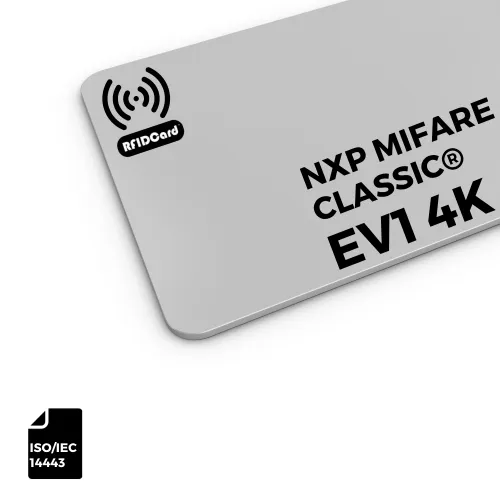
RFID Card NXP MIFARE Classic® EV1 4K (S70) CR80
The MIFARE Classic® EV1 4K RFID card is made with Photo-quality standard PVC sheets into the size of CR80, that are suitable for use with most direct thermal or thermal transfer card printers. MF1S70 series to be used in a contactless smart card according to ISO/IEC 14443 Type A.