
As businesses look for faster and more reliable ways to identify people, products, and assets, contactless identification technologies are becoming increasingly important. Traditional methods such as physical keys, printed tickets, and manual data entry can be slow, difficult to manage, and limited in scalability.
RFID cards are widely used in business environments where identification needs to be quick, convenient, and easy to integrate with an existing system. They can support applications ranging from employee access control and hotel room entry to event management, transportation, and asset tracking.
This guide explains what RFID cards are, how they work, the main types available, and the factors businesses should consider when selecting an RFID card for a specific application.
1. What Is an RFID Card?
An RFID card is a card-shaped identification device that uses radio-frequency communication to exchange data with a compatible reader without physical contact. It typically contains an RFID chip and an antenna, which are embedded within a card body made from plastic, or other suitable materials.
The RFID chip may store an identification number, user data, access permissions, or other application-specific information. Depending on the chip and system design, the card may support read-only, read-write, encryption, or authentication functions. Most RFID cards used for access control, hotel entry, transportation, and event management are passive, meaning they receive power from the reader’s radio signal instead of using a built-in battery.
For businesses, an RFID card is more than just a plastic card with an embedded chip. It is one component of an identification technology system that also includes an RFID reader, software, and a backend database. The card’s performance depends on several factors, including its operating frequency, chip type, memory capacity, communication protocol, reader compatibility, and intended application.

What Is an RFID Card Made Of?
An RFID card generally consists of three main elements:
- RFID chip: Stores or processes identification and application data.
- Antenna: Receives radio signals from the reader and enables wireless communication.
- Card substrate: Protects the chip and antenna and provides the card’s physical form.
PVC remains one of the most widely used materials because it is durable, flexible, cost-effective, and suitable for large-scale card production. For projects that prioritize sustainability or brand differentiation, manufacturers may also offer paper-based, wood-based, bio-based, or other alternative materials.
DIMENSIONS of RFID card
The primary RFID Card dimensions are known as “standard credit card” size, which is named ID-1 or CR80 and codified by the International Organization for Standards in the specification document ISO/IEC 7810 (Identification Cards–Physical Characteristics).

ISO/IEC 7810 specifies the size of ID-1/CR80 equals 85.60 by 53.98 millimeters (3 3⁄8″ × 2 1⁄8″ ), with a radius of 2.88–3.48 mm (about 1⁄8″ ) for round corners. The thickness of an RFID card varies from 0.5mm-1mm depending on the different production processes and customer needs.
There are other dimensions available, which as known as customized dimensions. If you want to understand how this standard fits within other card formats such as ID-2 and ID-3, we have a dedicated guide explaining ISO/IEC 7810 card sizes in detail.
2. How RFID cards work
How RFID cards work depends on the interplay of three key components: the RFID card, the reader, and the backend data system.

RFID card
The chip inside the RFID card is responsible for storing the card’s unique identification information. When the RFID card approaches the reader, the antenna on the card receives radio waves from the reader. This signal activates the chip, causing it to transmit the stored data back to the reader. This entire process takes place without direct contact, and the data exchange takes place within milliseconds.
RFID readers transmit radio signals. When an RFID card enters its signal range, the card’s antenna picks up these signals and activates the chip. The reader receives and processes the data returned by the card and transmits this information to the backend system.
Backend Data System
The backend data system receives and stores the data coming from the reader. This can be a simple database or a complex management system. The back office system is responsible for validating card information and performing actions as needed, such as updating inventory, recording entries and exits, or completing payments. These systems can often process data in real-time to ensure a quick response, such as opening a door or updating stock.
In order to understand more clearly how RFID cards work, we can use an example to explain.
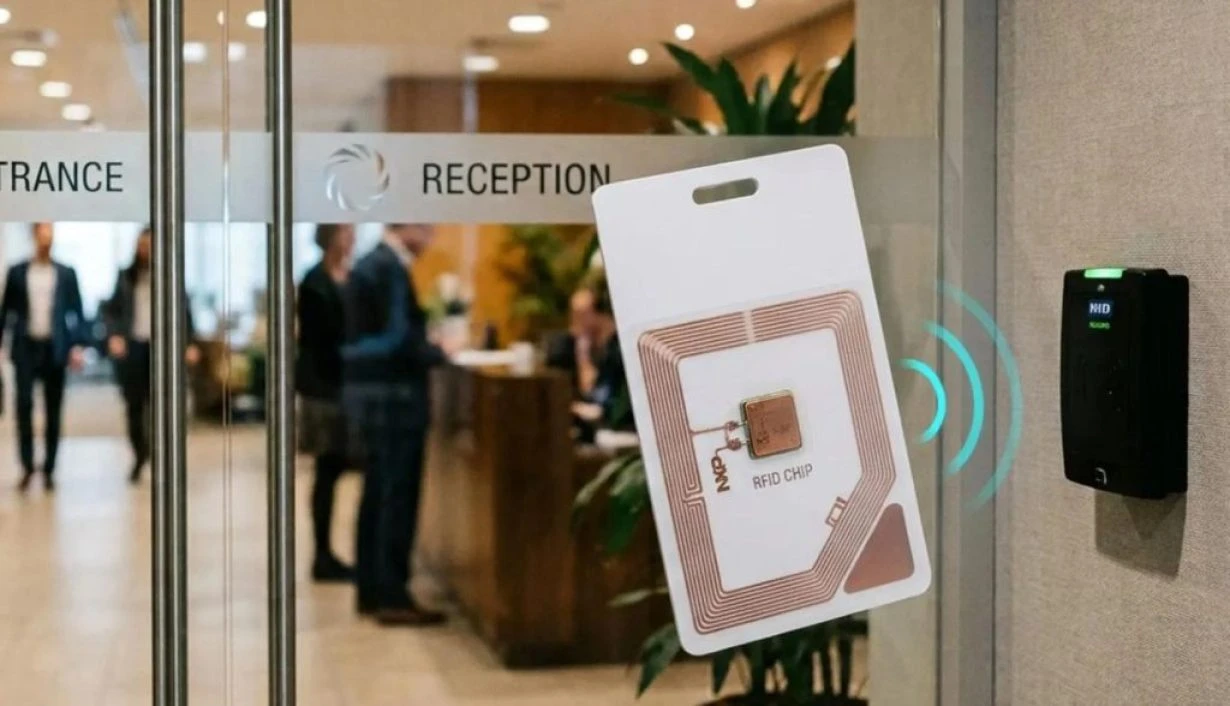
Example: In an office access control system, an employee presents an RFID card near a compatible reader. The reader captures the card’s identification data and sends it to the access control software for authorization. If the credentials are valid, the system unlocks the door and records the access event. This workflow allows organizations to manage permissions centrally and maintain an auditable record of entries.

3. Types of RFID cards
RFID cards can be categorized into different types based on the operating frequency and power supply method. Each type of RFID card has its unique characteristics and applicable scenarios.
Classified by Operating Frequency
| RFID Card Type | Operating Frequency | Features | Common Applications |
| Low Frequency (LF) | 125 kHz or 134.2 kHz | – Short reading range (a few centimeters to tens of centimeters) – Less interference from materials- Slower read/write speed | – Animal tracking (e.g., pet microchips) – Access control systems- Identification applications |
| High Frequency (HF) | 13.56 MHz (13.56MHz RFID Cards Explained) | – Medium reading range (a few centimeters to one meter)- Supports faster data transmission – Can store more information | – Public transportation systems (e.g., subway cards)- Library checkout systems – Payment and access control applications |
| Ultra-High Frequency (UHF) | 860-960 MHz | – Long reading range (several meters to tens of meters) – Supports higher reading speed- Can handle more data | – Logistics and asset management (e.g., cargo tracking, warehouse management) – Retail and supply chain management systems |
Classified by Power Supply
| RFID Card Type | Working Principle | Advantages & Disadvantages | Common Applications |
| Passive RFID Card | – No built-in battery – Activated by radio waves emitted from a reader | Advantages: – Low cost – Small size – Simple maintenance Disadvantages: – Short reading range – Depends on the signal strength of the reader | – Access control – Transportation ticketing – Retail management – Asset tracking- Inventory management |
| Active RFID Card | – Built-in battery – Can independently transmit signals | Advantages: – Long reading range – Supports higher data transmission rates Disadvantages: – Higher cost – Larger size – Requires regular battery replacement | – Logistics tracking – Asset management – High-end access control systems |
| Semi-Passive RFID Card | – Built-in battery to enhance chip performance – Still relies on external signals from the reader | Advantages: – Longer reading range than passive RFID cards – Faster data transmission Disadvantages: – Higher cost than passive RFID cards, but lower than active RFID cards | – Asset tracking – Inventory management |
Note: Passive RFID Card vs. Active RFID Card: Key Differences and Your Best Choice
4. RFID Card vs. NFC Card vs. Magnetic Stripe Card
RFID cards, NFC cards, and magnetic stripe cards are all used for identification, access, payment, or ticketing. However, they use different communication methods and offer different levels of convenience, security, compatibility, and scalability.
| Feature | RFID Card | NFC Card | Magnetic Stripe Card |
|---|---|---|---|
| Communication method | Radio-frequency communication | Near-field wireless communication | Magnetic data exchange |
| Physical contact required | No | No | Yes |
| Typical range | Depends on frequency and system design | Usually a few centimeters | Requires the card to pass through or contact the reader |
| Common frequencies | LF, HF, or UHF | 13.56 MHz | No radio frequency |
| Typical applications | Access control, hotel entry, inventory, transportation, asset tracking | Payments, mobile interaction, access control, ticketing | Legacy payment, membership, hotel, and access systems |
| Security | Depends on the chip, encryption, authentication, and system design | Often supports secure authentication and encryption, depending on the chip and application | Generally more vulnerable to wear, skimming, and magnetic data damage |
| Maintenance | Low for passive cards | Low | Higher because the magnetic stripe can wear or become demagnetized |
| Multi-item reading | Possible with some UHF systems | Generally designed for one-to-one close-range interaction | Not designed for wireless or multi-item reading |
RFID Cards
RFID is a broad identification technology that uses radio waves to exchange data between a card and a compatible reader. RFID cards can operate at different frequency bands, including LF, HF, and UHF.
Passive RFID cards do not require a built-in battery and are commonly used for employee access control, hotel room entry, event management, transportation, and membership programs. UHF RFID systems can also support longer-range identification and rapid reading of multiple items, making them suitable for inventory, logistics, and asset tracking.
The main advantage of RFID is its flexibility. Businesses can select a frequency, chip, memory capacity, security feature, and card material according to the requirements of their identification system.
NFC Cards
NFC is a short-range wireless communication technology that operates at 13.56 MHz. Many NFC cards are based on HF RFID standards, but RFID and NFC should not be treated as exactly the same technology. NFC is designed for very close-range communication and is commonly used for contactless payment, access control, ticketing, identity verification, and interaction with smartphones. If you’d like to learn more about the differences between the two, read the blog post, RFID Card vs. NFC Card: What’s the Difference?
NFC cards are a good choice when the application requires intentional tap-based interaction, strong user control, or compatibility with NFC-enabled mobile devices. However, NFC is usually not intended for long-range reading or high-volume multi-item identification.
For businesses choosing between an HF RFID card and an NFC card, the key consideration is not only the card itself but also the chip, communication protocol, reader, security requirements, and software platform.
Magnetic Stripe Cards
Magnetic stripe cards store data in a magnetic stripe on the back of the card. To read the information, the user must swipe the card through or along a compatible reader. Unlike RFID and NFC cards, magnetic stripe cards do not support contactless communication.
Magnetic stripe technology is relatively simple and may still be found in legacy payment, membership, hotel, and access systems. However, the stripe can become scratched, demagnetized, or unreadable over time. The card must also be physically swiped, which can create more friction for users and increase maintenance requirements.
For new identification technology projects, businesses should carefully evaluate whether magnetic stripe systems can meet their long-term requirements for security, convenience, integration, and scalability.

5. Wide range of applications
The flexibility and adaptability of RFID cards make them show a wide range of application potential in multiple industries. The following table is a common application scenario of RFID cards.
| Industry | Application of RFID Cards |
| Access Control | Secure building access for employees and visitors |
| Transportation | Contactless payment for public transit |
| Healthcare | Efficient patient and staff identification and tracking using RFID in healthcare. |
| Retail | Inventory management and theft prevention |
| Hospitality | Hotel room access and guest identification |
| Manufacturing | Process tracking and equipment access control |
| Education | Student and staff identification and attendance |
| Logistics | Supply chain tracking and inventory management |
| Sports | Ticketing and event access control |
| Libraries | Automated check-in and check-out for books |
| Agriculture | Livestock identification and tracking |
| Entertainment | Theme park admissions and ride access |
| Parking | Automated parking entry and exit |
| Security | Employee identification and restricted area access |
| Events | Attendee identification and access control |
6. RFID Card Communication Protocols
RFID communication protocols define how an RFID card and reader exchange data. They specify how devices identify each other, organize commands, transmit information, manage multiple cards, and handle security-related functions. The protocol must be supported by both the RFID card and the reader; cards that operate at the same frequency are not necessarily compatible.
Frequency and communication protocol are related but not interchangeable. Frequency refers to the radio band used for communication, while the protocol defines how the communication takes place. For example, two cards may both operate at 13.56 MHz but use different protocols, memory structures, security features, or reader technologies.

Common RFID Card Protocols by Frequency
LF RFID Protocols
Low-frequency RFID systems commonly operate at 125 kHz or 134.2 kHz. They are typically used for short-range identification, animal identification, and basic access control.
LF systems may use different standards or proprietary protocols depending on the application. For example, animal identification systems commonly follow ISO 11784/11785, while some access control systems use proprietary 125 kHz formats. As a result, an LF card designed for one access control system may not work with another reader, even when both operate at 125 kHz.
LF RFID is suitable for applications that require short-range identification and relatively good resistance to interference. However, it generally offers lower data rates and less memory than many modern HF or UHF systems.
HF RFID and NFC Protocols
High-frequency RFID systems commonly operate at 13.56 MHz. They are widely used for access control, hotel key cards, public transportation, event ticketing, payment, library systems, and other card-based identification applications.
Common HF-related standards and protocols include:
- ISO/IEC 14443: Commonly used for proximity cards, contactless smart cards, payment cards, and secure identification applications.
- ISO/IEC 15693: Designed for vicinity cards and applications that may require a longer reading distance than ISO/IEC 14443.
- ISO/IEC 18092: Defines the communication interface used by NFC devices in certain peer-to-peer and contactless communication scenarios.
- NFC Forum specifications: Support interoperability between NFC devices, cards, tags, and mobile phones.
Many NFC cards operate at 13.56 MHz and are based on technologies related to HF RFID. However, NFC and RFID should not be treated as identical. Compatibility depends on the specific chip, protocol, data format, security mechanism, and reader or mobile device.
For example, an HF access card using one ISO/IEC 14443-compatible chip may not be readable by a reader designed for another chip family. Before ordering cards, businesses should confirm the exact chip model and protocol supported by the existing reader system.
UHF RFID Protocols
UHF RFID systems are commonly used for inventory management, logistics, retail, supply chain, and asset tracking. Passive UHF RFID systems typically operate in regional frequency ranges within approximately 860–930 MHz.
The most widely recognized UHF protocol is the EPC UHF Gen2 air interface, also known as EPCglobal Class 1 Gen 2. It is standardized as ISO/IEC 18000-63 and defines how interrogators and passive UHF tags communicate. The protocol supports features such as tag identification, memory access, inventory operations, and the reading of multiple tags within the reader’s field.
UHF protocols are designed for applications that require longer reading distances and rapid identification of multiple items. However, actual performance depends on the reader, antenna, tag design, orientation, surrounding materials, regional regulations, and installation environment. A UHF card or tag should therefore be tested in the actual application environment before large-scale deployment.
7. Are RFID Cards Secure?
RFID cards can provide secure contactless identification, but RFID technology itself does not automatically guarantee security. The actual level of protection depends on the RFID chip, communication protocol, authentication method, encryption, reader configuration, backend software, and card management process.
A basic RFID card may only transmit a fixed identification number, while a secure contactless smart card can support encryption, mutual authentication, protected memory, and transaction-specific security functions. Therefore, businesses should evaluate the complete RFID identification system rather than judging security based only on the card’s frequency or physical appearance.
What Security Risks Should Businesses Consider?
The main security risks associated with RFID cards include:
- Unauthorized reading: An unauthorized reader may attempt to communicate with a card within its operating range.
- Card cloning: Cards that rely only on a fixed or publicly readable identification number may be easier to copy or imitate.
- Data interception: Weakly protected communication may expose information exchanged between the card and reader.
- Lost or stolen cards: If a card is not revoked promptly, another person may use it.
- System-level attacks: Weak reader configuration, poor key management, insecure software, or inadequate backend access controls can undermine an otherwise secure card technology.
The actual risk depends on the application. A simple membership card may require basic identification, while an employee access card, government document, payment card, or high-value asset identification system may require stronger authentication and data protection.
Are HF and NFC RFID Cards More Secure Than UHF Cards?
Security should not be determined by frequency alone. HF, NFC, and UHF technologies support different use cases, chip families, and communication standards. Some HF and NFC smart cards support advanced encryption and mutual authentication, making them suitable for secure access control, payment, ticketing, and identity applications.
Passive UHF RFID systems are widely used for inventory, logistics, retail, and asset tracking. Many UHF applications focus on fast identification and supply-chain visibility rather than storing sensitive personal information. Depending on the chip and protocol, UHF systems may also support access control, password protection, tag locking, data privacy features, and other security functions.
The correct question is not whether one frequency is universally safer. Businesses should ask whether the selected chip and protocol provide the security functions required by the intended identification workflow.
How Can Businesses Improve RFID Card Security?
Businesses can improve RFID card security by:
- Selecting a chip that supports encryption and mutual authentication when the application requires it.
- Avoiding systems that rely only on an unprotected, fixed card ID for high-risk access control.
- Using secure communication protocols and properly managing encryption keys.
- Restricting reader and backend system access according to user roles.
- Encrypting sensitive data and storing only the information necessary for the application.
- Immediately disabling lost, stolen, expired, or compromised cards.
- Keeping reader firmware, access control software, and backend systems updated.
- Testing the cards and readers in the actual installation environment before deployment.
- Maintaining access logs and reviewing unusual authentication activity.
- Defining a replacement and revocation process for the entire card lifecycle.
For most business applications, the card should not store unnecessary personal information. In many cases, the card can store a secure identifier while the associated user information remains in a protected backend system.
RFID Card Security Checklist
Before selecting an RFID card for an identification technology project, confirm:
- What information is stored on the card?
- Is the card ID fixed, writable, encrypted, or authenticated?
- Does the chip support mutual authentication?
- Can cards be revoked remotely or centrally?
- Does the reader support the selected security features?
- How are encryption keys created, stored, rotated, and replaced?
- What happens if a card is lost or copied?
- Are access events recorded and auditable?
- Has the complete card-reader-software system been tested together?
RFID cards can be a secure choice for access control, hotel entry, transportation, events, and asset management when the chip, protocol, reader, software, and card-management procedures are designed as one integrated system. Security should therefore be treated as a system architecture decision, not simply a card-material or frequency decision.
8. Customized RFID Cards
Customized RFID cards can not only strengthen your brand image but also accurately meet different business needs. Here are four points to pay attention to when customizing.
Design
Choose a personalized design, including colors, patterns, and corporate logos, to enhance brand recognition and visual appeal. This not only makes your RFID card unique but also effectively promotes your brand.
Size
Adjust the card size according to actual usage needs, from standard credit cards to special sizes, to ensure that RFID cards are suitable for various application scenarios, such as small devices or specific containers.
Material
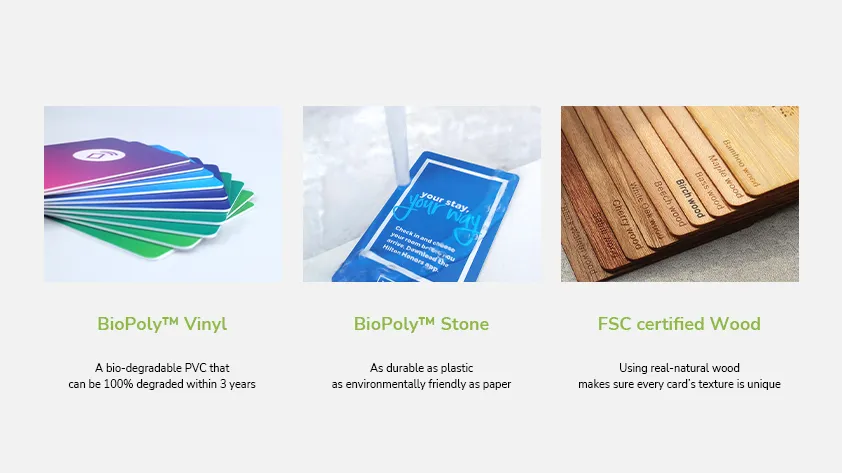
Choose suitable materials, such as PVC, BioPoly™ Vinyl, BioPoly™ Stone, and certified Wood, to meet the usage requirements in different environments. Choosing the right material can enhance the durability and functionality of the card.
Printing and other processes
RFID cards can be pre-printed with complex patterns through offset printing, digital printing or screen printing. There are many other processes to choose from, such as serial number printing; barcode or QR code printing (generated based on UID); or magnetic stripe attachment, etc.
Benefits of customization
Improve brand recognition
With customized design, RFID cards can become a powerful tool for brand promotion, enhancing the professional image of the company and customer memory.
Meet specific needs
Customized RFID cards can be optimized according to actual business needs, such as access control level or special design, to ensure efficient business operations.
Enhance security
Integrate anti-counterfeiting technology and encryption functions in the card to improve data security and prevent counterfeiting and unauthorized use.
Optimize user experience
Provide a more comfortable operating experience and improve user satisfaction by adjusting the size and shape of the card.
9. How to Choose the Right RFID Card
Choosing the right RFID card depends on how it will be used within your identification technology system. Before placing an order, consider the required reading distance, reader compatibility, security features, encoding method, card material, order quantity, and operating environment.
First, make sure the card uses the correct frequency, chip, protocol, and reader technology. Cards operating at the same frequency are not always compatible, so sample testing with the existing reader and software is recommended. The required reading range also depends on the card, antenna, reader, installation position, and surrounding materials such as metal or liquid.
Security and personalization requirements should also be evaluated. Applications such as employee access control may require encryption, authentication, and centralized card management, while basic membership cards may only need a unique identifier. Businesses should also choose a material that matches the expected durability, temperature, moisture, and printing requirements.
Finally, consider whether the cards will be supplied blank, printed, encoded, or fully personalized. Order quantity, replacement needs, production setup, and shipping can all affect the total cost. Testing a sample in the actual application environment before mass production can help confirm reliable performance and avoid compatibility problems.

9. The Future of RFID Cards: What to Expect
Technological Advances
- Improved Data Security: As the focus on data security increases, RFID cards will adopt more advanced encryption technology and security protocols to prevent data leakage and malicious attacks. Future RFID cards will have stronger data protection capabilities to ensure the security of user information.
- Integration and Interoperability: RFID cards will be seamlessly integrated with other technologies such as the Internet of Things (IoT), Artificial Intelligence (AI) and Blockchain to achieve smarter systems and application scenarios.
Market Trends
- Personalization and Customization: With the increasing demand for personalization and customization, future RFID cards will provide more design options and functional configurations to meet specific needs. Enterprises can customize RFID cards according to their requirements and provide personalized services.
- Environmental Protection and Sustainability: Environmental protection and sustainable development will become important considerations in the production of RFID cards. Future RFID cards will use environmentally friendly materials and processes to reduce environmental impact and meet global sustainable development standards.
The future of RFID cards is full of opportunities and challenges. Technological advances will lead to smarter and safer RFID cards, while market trends will drive wider applications and customization. By paying attention to these trends, your business can take advantage of RFID card innovations to improve business efficiency, meet market demands, and achieve digital transformation.
You Might Also Be Interested In:
Best RFID Cards in 2026: Types, Features, and How to Choose the Right One
Best RFID Chips for Different Applications: A Practical Selection Guide
The Hidden Cost Savings of RFID Hotel Key Cards vs. Magnetic Stripe Cards
Why Choose Wooden RFID Cards? 5 Reasons You Need to Know
RFID Key Card vs. Magnetic Stripe Key Card: How to Choose?
FAQs
Can RFID Cards Work Through a Wallet or Other Materials?
Yes, RFID cards can usually be read through thin, non-metallic materials such as a wallet, card holder, or plastic sleeve. However, the reading distance may be reduced by card orientation, multiple contactless cards, metal components, or protective RFID-blocking materials. For reliable performance, test the card with the intended reader, wallet, card holder, and installation environment.
Can Two RFID Cards Interfere with Each Other?
Yes, two or more RFID cards may interfere with each other when they are presented to the same reader at the same time. The result depends on the frequency, chip technology, reader design, card orientation, and system anti-collision features. Users may experience a failed or inconsistent read. Applications requiring reliable one-card identification should test cards in their actual use environment.
Can an RFID Card Be Reused After a User or Guest Changes?
In many systems, an RFID card can be reused after the previous user or guest is removed from the backend system and the card is re-encoded or reassigned. The exact process depends on the chip, access control software, and card-management policy. Before reuse, businesses should revoke the previous credential, verify the new permissions, and confirm that old access data cannot be used.
Does an RFID Card Need to Store Personal Information?
No. An RFID card does not usually need to store a person’s name, address, or other personal information. Many systems store only a unique identifier or encrypted credential on the card, while the related user data remains in a protected backend database. Storing less sensitive information on the card can reduce privacy risks and simplify card replacement, revocation, and system management.
How secure are RFID cards?
RFID cards offer various security features, such as encryption and authentication, to protect data. However, security can vary based on card technology and implementation. For detailed security considerations, refer to our RFID Card Security Overview.
What needs to be considered when buying RFID cards?
When purchasing RFID cards, consider factors such as the card type (LF, HF, or UHF), compatibility with your readers, durability, and any customization needs. For a comprehensive guide on selecting the right RFID cards, check out our RFID Card Purchasing Guide.
How much do RFID cards cost?
The cost of RFID cards depends on factors such as type, quantity, and customization. Prices generally range from a few cents to several dollars per card. For detailed pricing and personalized assistance, please contact our online customer service and sales team.
What Should I Test Before Placing a Large RFID Card Order?
Before mass production, test sample cards with the actual reader, software, card holder, and installation environment. Check reading distance, read consistency, card orientation, encoding accuracy, authentication, printing quality, and resistance to heat, moisture, bending, or abrasion. Also confirm the chip, protocol, memory, material, dimensions, and personalization requirements. Written acceptance criteria can help prevent compatibility and quality problems.