In today’s interconnected world, RFID card technology has become a cornerstone of digital transformation across industries—from logistics and warehousing to transportation, retail, and access control. Yet, the true effectiveness of an RFID system depends not only on hardware quality but also on the standards that ensure global interoperability. One such critical standard is ISO/IEC 18000-63, which defines the air interface protocol for UHF RFID systems operating in the 860–960 MHz frequency range. Compliance with this standard is far more than a technical checkbox—it’s a guarantee of reliability, compatibility, and long-term system scalability for your RFID infrastructure.
1. What Exactly is ISO/IEC 18000-63?
The ISO/IEC 18000 family of standards defines how RFID systems communicate across different frequency bands and environments. Within this family, ISO/IEC 18000-63 specifically covers the UHF (Ultra High Frequency) range and outlines the communication protocol between the RFID tag (or card) and the reader. It is internationally recognized as the foundation of EPCglobal Class 1 Gen2v2, the most widely adopted RFID standard for supply chain management and industrial tracking.
Technically speaking, ISO/IEC 18000-63 ensures that RFID cards and readers share a common language—covering aspects such as data encoding, anti-collision algorithms, memory structure, and error handling. This standard allows multiple tags to be read simultaneously, even in environments with dense tag populations, while maintaining high accuracy and fast communication speed.
In simpler terms, ISO/IEC 18000-63 is what allows RFID systems built by different manufacturers to work together seamlessly, supporting the global scalability that modern enterprises demand.
2. The Imperative of Compliance in RFID Card Systems
When organizations invest in RFID technology, they often focus on visible performance indicators—read range, tag durability, or card design. However, behind every successful deployment lies the assurance of compliance. Using RFID cards that meet ISO/IEC 18000-63 standards ensures that your system operates reliably and integrates smoothly with other compliant components, regardless of brand or manufacturer.

2.1 Interoperability: The Cornerstone of a Functional System
Compliance is the foundation of interoperability—the ability of different components (tags, readers, and middleware) from various manufacturers to work together seamlessly. Without a unified standard like ISO/IEC 18000-63, every manufacturer would develop its own proprietary communication protocol. This would result in a fragmented ecosystem where a reader from Vendor A could not reliably read a tag from Vendor B, trapping organizations in costly, single-vendor solutions.
By mandating a common air interface, the standard liberates organizations, allowing them to select the best-in-class components for each part of their system. This is particularly critical for large enterprises that operate across multiple sites or integrate with external partners who may use different hardware.
2.2. Preventing Technical Failures
Non-compliant RFID cards may function inconsistently, leading to issues like short read ranges, unstable communication, or signal interference. In high-volume environments such as warehouses or production lines, these failures translate directly into lost productivity and data inaccuracies. Choosing ISO/IEC 18000-63 compliant RFID cards ensures consistent performance across varied conditions and frequencies.
2.3 Compatibility with Enterprise Ecosystems
Modern RFID systems are rarely standalone. They must integrate with existing enterprise resource planning (ERP) systems, warehouse management systems (WMS), and other supply chain software. Leading RFID hardware manufacturers—such as Impinj, Zebra, and Alien Technology—design their readers and infrastructure to strictly adhere to the ISO/IEC 18000-63 protocol. Using compliant cards ensures immediate, plug-and-play compatibility with these industry-leading systems, simplifying deployment and reducing the need for custom integration work.
3. Key Strategic Benefits of ISO/IEC 18000-63-Compliant RFID Cards

Beyond basic functionality, compliance with ISO/IEC 18000-63 unlocks several strategic advantages that future-proof your investment and enhance your competitive edge.
3.1 Global Compatibility and Regulatory Adherence
ISO/IEC 18000-63-compliant RFID cards operate across the UHF spectrum used worldwide, ensuring smooth performance whether your business runs in Asia, Europe, or the Americas. This is particularly beneficial for international logistics companies or manufacturers with multi-site operations that require unified tagging systems.
3.2 Enhanced Read Performance and Speed
The technical specifications within the standard dictate highly efficient anti-collision algorithms and optimized communication protocols. This results in:
- Faster Inventory Counts: Compliant systems can read tags at speeds exceeding 1,000 tags per second, drastically reducing the time required for inventory checks.
- Higher Read Accuracy: The robust nature of the protocol ensures a higher percentage of successful reads, even in challenging environments with dense tag populations or high levels of electromagnetic interference.
3.3 Improved Security and Data Integrity
The latest version of the protocol, Gen2v2 (which is synonymous with ISO/IEC 18000-63), introduced critical security features that are essential for protecting sensitive data and preventing counterfeiting. These features include:
- Authentication: The ability for the reader to verify the authenticity of the tag, preventing the use of unauthorized or cloned tags.
- Encryption: Support for cryptographic methods to secure the data transmitted between the tag and the reader, protecting privacy and data integrity.
- Untraceability: Mechanisms to prevent unauthorized tracking of items by third parties, a growing concern in consumer privacy.
Choosing compliant cards means you are leveraging the most advanced security features available in the UHF RFID space, safeguarding your assets and your data.
4. How to Ensure You Are Choosing ISO/IEC 18000-63 Certified RFID Cards
Selecting the right RFID card begins with verifying compliance. Here’s how to identify products that truly meet ISO/IEC 18000-63 standards:
- Check Product Datasheets – Look for explicit statements like “ISO/IEC 18000-63 compliant” or “EPC Gen2v2 compatible” in the technical documentation.
- Review Certification Reports – Reputable manufacturers provide third-party test results from accredited labs that verify frequency range, modulation type, and protocol conformance.
- Identify the Chip Model – Chips such as Impinj Monza, NXP UCODE, and Alien Higgs are well-known for meeting ISO/IEC 18000-63 requirements.
- Partner with Experienced Manufacturers – Collaborate with suppliers who have a proven track record of delivering certified RFID solutions for industrial and commercial environments.
Compliance verification is a simple step that prevents costly compatibility issues later in your deployment.
5. Conclusion
Choosing ISO/IEC 18000-63-compliant RFID cards is not just about meeting specifications—it’s about investing in reliability, efficiency, and future-proof performance. As enterprises continue to digitize operations and automate workflows, the need for standard-based interoperability has never been greater. In the rapidly evolving world of industrial automation, compliance is not merely a technical label—it is the key to long-term operational success. Partner with RFIDCard to ensure your system performs at its best—today and in the future.
FAQs
1. What’s the difference between ISO/IEC 18000-63 and ISO/IEC 14443?
The primary difference lies in the operating frequency and application.
- ISO/IEC 18000-63 defines UHF RFID (860–960 MHz), enabling long-range reading—typically several meters—and is ideal for logistics, warehouse automation, and industrial tracking.
- ISO/IEC 14443, on the other hand, defines HF/NFC (13.56 MHz) communication, commonly used for short-range applications like contactless payment cards, transit passes, and secure access control.
2. What’s the difference between ISO/IEC 18000-63 and ISO/IEC 18000-6C?
There is actually no difference between ISO/IEC 18000-63 and ISO/IEC 18000-6C. They refer to the same international standard for UHF RFID communication protocols (operating in the 860–960 MHz frequency range).
3. Can ISO/IEC 18000-63 cards be used for access control?
While technically possible, ISO/IEC 18000-63 (UHF) is generally not the preferred standard for traditional, close-range access control. The long read range of UHF can be a security risk, as a card could be read from a distance without the user’s knowledge. For secure, short-range access control, ISO/IEC 14443 (HF) is the industry standard. However, UHF cards are commonly used for vehicle access control (e.g., gate entry) where the long read range is a benefit for hands-free identification.
Recommended Product
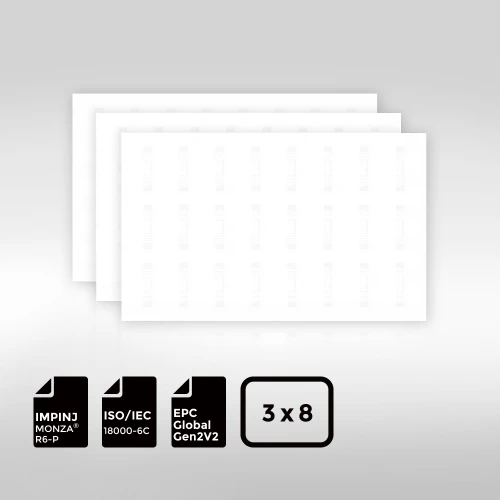
BioPoly™ Vinyl RFID Inlay Sheet Impinj® Monza® R6-P

The Impinj® Monza® R6-P BioPoly™ Vinyl RFID Inlay features the high-performance Monza® R6-P chip, known for its exceptional read range, reliability, and accuracy. This chip optimizes inventory and asset tracking, ensuring fast and efficient data capture in various applications. While offering cutting-edge RFID technology, the inlay also utilizes eco-friendly BioPoly™ Vinyl, a biodegradable PVC made with renewable materials that degrades within three years, reducing environmental impact without compromising performance. The combination of the Monza® R6-P chip and sustainable BioPoly™ Vinyl makes this inlay a powerful, environmentally responsible solution for modern RFID needs.