In today’s digital world, we interact with various forms of cards daily. From hotel access cards to public transportation payment cards and the bank cards in our wallets, these small plastic pieces carry vital information and functions. Among them, Radio Frequency Identification (RFID) cards play an increasingly important role in many fields due to their convenient contactless features. But have you ever wondered how these seemingly simple RFID cards became so intelligent and secure? Behind the scenes, an international standard known as ISO/IEC 7816 plays a crucial role. It elevates RFID cards from basic identity tags to powerful “secure microcomputers.”
1. ISO/IEC 7816 Standard: The Foundation of Smart Cards

ISO/IEC 7816 is a series of standards jointly developed by the International Organization for Standardization (ISO) and the International Electrotechnical Commission (IEC). It was originally created to standardize contact-based integrated circuit cards, commonly known as smart cards. These standards define the physical characteristics, electrical interfaces, communication protocols, internal data structures, and security mechanisms of smart cards. Simply put, ISO/IEC 7816 provides a universal “language” and “operating guidelines” for smart cards, ensuring cards and readers produced by different manufacturers are compatible and can exchange data securely.
This standard series comprises multiple parts, each focusing on different aspects of smart cards.
- ISO/IEC 7816-1: Specifies the card’s physical characteristics, such as dimensions and curvature, ensuring it can be properly handled by various devices.
- ISO/IEC 7816-2: Defines the dimensions and positioning of contacts on the card, guaranteeing readers can accurately connect to the card’s electronic components.
- ISO/IEC 7816-3: Describes the electrical signals and communication protocols between the card and reader. This acts as the rules for communication between the card and reader, ensuring they can understand the information exchanged.
- ISO/IEC 7816-4: This critical part defines the card’s internal data organization, file structure, secure access methods, and a set of universal commands. This enables the card to manage data like a mini file system while enforcing strict access controls.
- ISO/IEC 7816-15: Focuses on cryptographic applications within the card, providing robust encryption and digital signature capabilities to further enhance security.
2. The Shift from “Labels” to “Microcomputers”

Although ISO/IEC 7816 was originally designed for contact smart cards, its core principles and security framework have profoundly influenced the development of RFID cards. Particularly for RFID cards requiring high security and complex functionality—such as those used for payment, access control, or authentication—they often adopt certain aspects of ISO/IEC 7816, especially its provisions for data management and security. This evolution transforms RFID cards from simple “tags” into “microcomputers” with processing capabilities.
This shift manifests primarily in the following aspects:
- Data Organization and Management Capabilities: Traditional RFID tags typically store only a simple identification code or minimal data. In contrast, RFID cards compliant with ISO/IEC 7816 can possess a complex file system, analogous to the folder structure on a computer. This allows cards to store different types of data, categorize and manage it, enabling them to handle more complex application scenarios.
- Built-in Security Mechanisms: The ISO/IEC 7816 standard provides robust security safeguards for cards. It mandates multiple security features, including user authentication (e.g., PIN verification), data encryption, digital signatures, and strict access controls. This ensures only authorized users or devices can access sensitive information on the card, while data remains protected during transmission, significantly reducing the risk of theft or tampering.
- Command and Response Protocol: ISO/IEC 7816-compliant RFID cards can understand and execute a series of complex commands. Readers no longer merely read data from the card; they can send instructions to the card, such as “read a specific file,” “perform an encryption operation,” or “verify user identity.” The card processes these instructions and returns the corresponding response. This “dialogue” capability is a key feature of the microcomputer.
- Integrated Microcontroller: Many high-end RFID cards incorporate a microcontroller internally, which is the core reason they are called “microcomputers.” This microcontroller incorporates components like a central processing unit (CPU), random access memory (RAM), read-only memory (ROM), and electrically erasable programmable read-only memory (EEPROM). It can execute program code, perform complex calculations, and manage all internal card resources. This enables the card to independently accomplish numerous tasks beyond merely passively providing data.
3. Comparison of Traditional RFID Tags and ISO/IEC 7816-Compliant RFID Cards
To better understand the transformation brought by the ISO/IEC 7816 standard, we can compare traditional RFID tags with RFID cards compliant with this standard:
| Characteristics/Standards | Traditional RFID tags | RFID cards compliant with ISO/IEC 7816 |
| Functionality | Simple data storage and identification | Data storage, processing, encryption, authentication, access control |
| Security | Low, susceptible to cloning or tampering | High, with built-in encryption modules and security protocols |
| Processing Capability | None or extremely limited | Equipped with microcontrollers capable of complex operations |
| Communication Protocol | Typically simple read/write protocol | Follows APDU (Application Protocol Data Unit) command structure |
| Application Scenarios | Logistics tracking, inventory management, anti-counterfeiting | Payments, access control, identity verification, public transit, e-passports |
| Cost | Lower | Higher |
As shown in the table above, RFID cards compliant with the ISO/IEC 7816 standard demonstrate significant enhancements in functionality, security, and processing capabilities. They are no longer mere identification tools but intelligent devices capable of executing complex tasks and protecting sensitive information.
Conclusion
The ISO/IEC 7816 standard plays a pivotal role in the smart card and RFID card sectors. It provides these cards with a robust technical foundation and a stringent security framework, enabling their evolution from simple information carriers into powerful “secure microcomputers.” For RFID applications requiring high security and complex functionality—such as hotel key cards, access control cards, and payment cards—adherence to the ISO/IEC 7816 standard is essential for ensuring reliability and security.
At RFIDCard, we fully recognize the importance of these standards and are committed to providing customers with products that meet world-class quality benchmarks. We cater to your diverse needs in security, efficiency, and customization. Should you have any questions about our products or RFID solutions, please feel free to contact us anytime.
Recommended Product
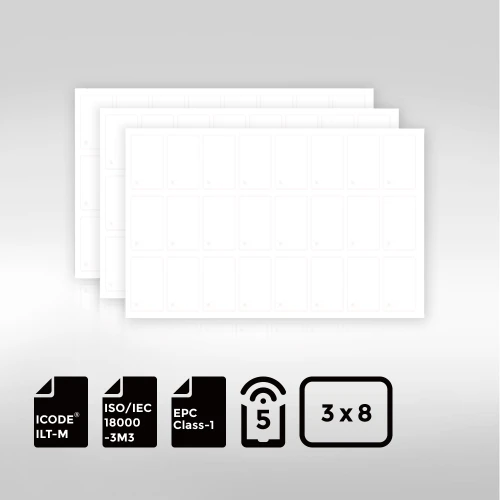
BioPoly™ Vinyl RFID Inlay Sheet NXP® ICODE® ILT-M

The NXP® ICODE® ILT-M BioPoly™ Vinyl RFID Inlay Sheet combines cutting-edge high-frequency RFID performance with a commitment to sustainability. Featuring the advanced ICODE® ILT-M chip and compliant with ISO/IEC 18000-3 Mode 3, it delivers ultra-fast data transfer, high memory capacity, and superior reading distances, making it ideal for applications such as supply chain management, asset tracking, logistics, and industrial automation.
Made from eco-friendly BioPoly™ vinyl, this inlay sheet helps your business reduce its environmental footprint while maintaining exceptional durability and printability. Whether used in custom labels, smart packaging, or intelligent inventory systems, the ILT-M BioPoly™ enables your brand to achieve operational efficiency, environmental responsibility, and a stronger connection with customers—all in one smart solution.