


If you’re sourcing smart cards for your business, you’ve probably asked:
Is MIFARE® NFC or RFID?
It’s a common question—with important implications.
Understanding the difference helps you avoid compatibility issues, especially if your system involves mobile access, NFC readers, or secure authentication.
In this guide, we’ll break down what MIFARE® really is, how it relates to RFID and NFC, and which card type is right for your application.
Quick Answer: Is MIFARE® NFC or RFID?
MIFARE® is a family of HF RFID-based contactless smart card technologies developed by NXP. It operates at 13.56 MHz and is commonly used in applications such as access control, transportation, and identification systems.
NFC and MIFARE® are closely related but are not the same. NFC is a communication technology that enables compatible devices, such as smartphones and NFC readers, to interact with certain RFID-based cards and tags. Some MIFARE® products are NFC-compatible depending on the chip, device support, and application requirements.
1. The Basics — RFID, NFC, and MIFARE® Explained
Before we dive into compatibility details, it’s important to understand how RFID, NFC, and MIFARE® relate to each other. RFID is a broad identification technology that includes multiple frequency ranges, while NFC and MIFARE® are mainly associated with the 13.56 MHz HF RFID frequency band. Although they are closely related, they serve different purposes and follow different technical standards.
What is RFID?
Radio Frequency Identification (RFID) is a wireless communication technology used to identify and track tags attached to objects. RFID operates across different frequency bands, including:
- Low Frequency (LF) – 125 kHz
- High Frequency (HF) – 13.56 MHz
- Ultra-High Frequency (UHF) – 860–960 MHz
MIFARE® cards belong to the HF RFID category, which is widely used for access control, transit systems, cashless payments, and secure identification.
What is NFC?
Near Field Communication (NFC) is a subset of HF RFID, designed for short-range communication between devices, such as smartphones and readers. NFC is defined by the NFC Forum and based on the ISO/IEC 14443 standard (same as many contactless smart cards).
In short:
All NFC is HF RFID, but not all HF RFID is NFC.
NFC enables two-way communication and is commonly used in mobile payments, contactless check-ins, and digital identity.

What is MIFARE®?
MIFARE® is a family of contactless smart card technologies developed by NXP Semiconductors. It is one of the most widely used HF RFID platforms in the world, especially in:
- Secure access control systems
- Public transportation ticketing
- Event credentialing
- Campus and hotel card systems
All MIFARE® products operate at 13.56 MHz and comply with ISO/IEC 14443 Type A, making them part of the HF RFID spectrum.
The most common MIFARE® product lines include:
Each has different capabilities in terms of memory size, security level, and compatibility with NFC devices—topics we’ll explore in the next sections.
2. So, Is MIFARE® an NFC or RFID Card?
The straightforward answer is:
MIFARE® cards are based on HF RFID technology. Depending on the specific chip and application, some MIFARE® products can also be compatible with NFC-enabled devices.
Here’s what that means for your business:
MIFARE® cards use RFID technology operating at 13.56 MHz and follow the ISO/IEC 14443 Type A standard, making them part of the high-frequency RFID family.
NFC is a communication protocol built on top of HF RFID, enabling peer-to-peer and smartphone interactions.
But what about NFC compatibility?
Not all MIFARE® cards are NFC-compatible, but some are designed to work with NFC-enabled devices like smartphones:
| MIFARE® Card Type | NFC Compatibility | Typical Use Cases |
| MIFARE Classic® | ❌ Not truly NFC compatible | Older door access systems, enterprise badges |
| MIFARE Ultralight® | ✅ NFC Forum Type 2 compliant | Contactless transit tickets, event access |
| MIFARE® DESFire® EV1/EV2/EV3 | ✅ NFC Forum Type 4 compliant | High-security access control, mobile payments, identity |
Why isn’t MIFARE® Classic NFC compatible?
MIFARE® Classic uses a proprietary Crypto-1 encryption algorithm and a non-standard communication frame. While some Android devices with built-in NXP NFC chips can read MIFARE® Classic, most smartphones—including iPhones—cannot reliably read or interact with these cards.
This incompatibility can cause challenges if your system relies on smartphone NFC functionality for access or authentication.
What does this mean for your business?
Understanding which MIFARE® card your application requires—and its NFC compatibility—is critical to avoid costly system mismatches and to ensure a seamless user experience, especially in environments where mobile device interaction is expected.
3. How to Choose the Right MIFARE® Card for Your Application?
Selecting the appropriate MIFARE® card type is crucial for ensuring smooth operation, security, and compatibility in your business environment. Here are the key factors to consider:

Do You Need Smartphone Compatibility?
If your application involves NFC-enabled smartphones for access or identification, choose card technologies that support the required NFC standards, such as MIFARE® DESFire® or Ultralight® where applicable. The final compatibility depends on the mobile access platform, reader system, security requirements, and credential configuration.
Avoid MIFARE® Classic if mobile device interaction is required, as most phones can’t read or emulate these cards reliably.
Security Requirements
MIFARE® Classic uses older Crypto-1 encryption and offers lower security, suitable for less critical access control.
MIFARE® Plus and DESFire® cards provide advanced encryption (AES) and better protection against cloning and hacking.
For applications requiring high security—such as corporate buildings, government, or payment systems—DESFire® EV2 or EV3 is recommended.
System Compatibility
Ensure your existing card readers support the specific MIFARE® card type. All MIFARE® cards comply with ISO/IEC 14443 Type A, but some advanced features require compatible reader firmware.
Upgrading from Classic to DESFire® might require reader firmware or hardware updates.
Budget and Volume
MIFARE® Classic cards are generally the most cost-effective.
Higher security cards like DESFire® come at a premium but offer longer-term value through enhanced security and compatibility.
Consider volume discounts and custom printing options when ordering.
Application Scenario
| Application Type | Recommended MIFARE® Card | Reason |
| Basic access control | MIFARE Classic® | Cost-effective, widely supported |
| High-security access | MIFARE® DESFire® EV2/EV3 | Advanced security, NFC mobile support |
| Public transit / Event | MIFARE Ultralight® | NFC compatible, lightweight and cheap |
| Multi-application cards | MIFARE® DESFire® | Supports multiple apps and secure storage |
Choosing the right MIFARE® card ensures you avoid costly upgrades or compatibility issues later on, providing a smooth user experience and robust security tailored to your needs.
4. Looking for MIFARE® cards for your project?
We offer a full range of genuine MIFARE® cards, including:
- MIFARE Classic® 1K/4K
- And MIFARE® DESFire® EV1, EV2, EV3
- MIFARE Ultralight® & Plus®
Custom printing, pre-encoding, and bulk pricing available
Contact our team today for free technical consultation or to request sample cards.
Let us help you build a smart, future-ready access solution.
FAQs
1. Is MIFARE® the same as NFC?
No. MIFARE® is a type of high-frequency (HF) RFID card developed by NXP. Some MIFARE® cards, such as DESFire® or Ultralight®, are compatible with the NFC standard, but not all. For example, MIFARE® Classic is not fully NFC-compatible and can’t be read by most smartphones.
2. Can I use my smartphone to read a MIFARE® card?
It depends on the card type.
Compatible: MIFARE® DESFire®, MIFARE® Ultralight®
Not compatible: MIFARE® Classic (due to proprietary encryption and non-standard protocol)
Some Android phones with NXP chips may partially read MIFARE® Classic, but this is not reliable across all devices. iPhones do not support MIFARE® Classic at all.
3. How do I know if my system supports MIFARE® cards?
Check whether your readers support the specific MIFARE® chip type you plan to use, including required protocols, security features, and application functions. ISO/IEC 14443 Type A support is a basic requirement, but complete compatibility may also depend on reader firmware, system configuration, encryption keys, and credential management requirements.
4. Which MIFARE® card is best for mobile-friendly access systems?
MIFARE® DESFire® EV2 or EV3 is commonly selected for secure NFC-based access applications because it supports NFC Forum Type 4 specifications and advanced security features. However, mobile access compatibility depends on the complete solution, including the smartphone platform, access control provider, reader system, and credential management process.
5. Can I upgrade from MIFARE® Classic to a more secure option?
Yes. Many businesses are migrating from MIFARE® Classic to MIFARE® DESFire® or MIFARE® Plus®. We can support you with upgrade strategies, card reissuance, and compatible reader options to ensure a smooth transition.
Recommended Product
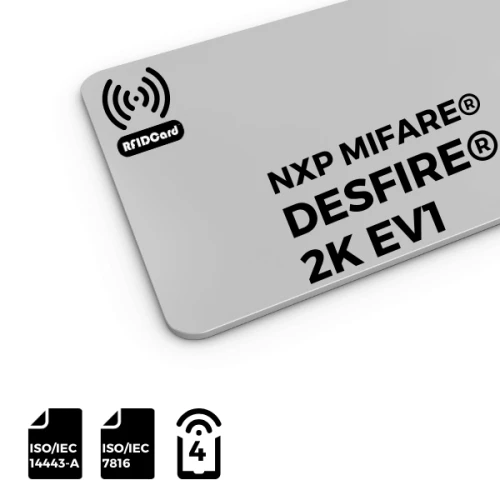
RFID Card CR80 MIFARE® DESFire® EV1 2K

The MIFARE® DESFire® EV1 2K RFID card is a secure, high-capacity contactless smart card ideal for various applications like access control, transportation, and payment systems. It features 2KB of integrated memory, advanced encryption standards for security, and is compatible with existing MIFARE® systems.


