
MIFARE® RFID cards are widely used in access control, transportation, hospitality, and identification systems. However, different MIFARE families provide different levels of security, memory capacity, and functionality, making it important to select the right card for each application.
This guide explains the differences between MIFARE Classic®, MIFARE Ultralight®, MIFARE Plus®, and MIFARE DESFire®, helping organizations choose the right MIFARE card based on security requirements, system compatibility, and application needs.
1. What is a MIFARE® RFID Card?
A MIFARE® RFID card is a contactless smart card based on NXP Semiconductors’ MIFARE® technology, which uses high-frequency (HF) RFID communication to exchange data with compatible readers. Operating at 13.56 MHz and based on the ISO/IEC 14443 standard, MIFARE® cards enable secure and convenient contactless identification and data exchange. ( If you are comparing MIFARE® with broader RFID and NFC technologies, see the guide on MIFARE® vs. NFC vs. RFID: Don’t Buy the Wrong Card.)
Unlike traditional RFID cards that mainly provide basic identification functions, MIFARE® cards are designed with different memory capacities, security features, and application capabilities to meet various system requirements. Depending on the card family, MIFARE® technology can support applications ranging from simple identification and ticketing to more advanced access control, transportation, and multi-application systems.

The MIFARE® product family includes several card series, such as MIFARE Classic®, MIFARE Ultralight®, MIFARE Plus®, and MIFARE DESFire®. Each series is designed for different levels of security, data storage needs, and application environments.
When selecting a MIFARE® RFID card, organizations should consider factors such as application requirements, security level, reader compatibility, memory capacity, and future system scalability to choose the most suitable option.
2. Why Do MIFARE® Cards Have Different Series?
MIFARE® cards are designed for different application requirements rather than a single use case. Different projects may require different levels of security, memory capacity, processing capability, and system functionality. To meet these needs, NXP has developed multiple MIFARE® card families, each optimized for specific applications.
2.1 Different Security Levels for Different Requirements
Security requirements vary significantly between RFID applications. Some systems only need basic identification, while others require advanced authentication and data protection.
Different MIFARE® families provide different security capabilities, including:
- Basic identification: Suitable for applications where simple card recognition is required.
- Authentication: Enables systems to verify whether a card is authorized for a specific application.
- Encryption and advanced protection: Designed for applications requiring stronger data security.
- Multi-application support: Allows one card to support multiple functions with controlled access permissions.
For example, MIFARE Classic® is commonly used in existing basic identification systems, while MIFARE DESFire® is designed for applications requiring advanced security features and flexible data management.
2.2 Different Memory and Function Options
MIFARE® card families provide different memory capacities and functional capabilities to support various application scenarios.
Depending on the card type, MIFARE® technology can support:
- Small memory applications: Suitable for tickets, events, and other high-volume applications where limited data storage is required.
- Credential-based applications: Used for access control, identification, and authentication systems.
- Multi-application systems: Designed for solutions that require multiple services or data structures on a single card.
The availability of different memory sizes and functions allows organizations to select a MIFARE® card that matches their specific system requirements without choosing unnecessary features.
2.3 Wide Industry Adoption and System Compatibility
Another reason MIFARE® cards are widely adopted is their long-term presence in the RFID industry and broad ecosystem support.
Many organizations choose MIFARE® technology because of:
- Existing infrastructure: A large number of RFID systems and readers already support MIFARE® products.
- Reader ecosystem: Compatibility with various RFID readers and system platforms helps simplify deployment.
- Long-term scalability: Different MIFARE® families allow organizations to select solutions that can support current needs and future upgrades.

3. MIFARE® Card Families Explained
The MIFARE® product family includes several card series designed for different security requirements, memory capacities, and application needs. The main MIFARE® RFID card families include MIFARE Classic®, MIFARE Ultralight®, MIFARE Plus®, and MIFARE DESFire®.
While all MIFARE® cards use contactless RFID technology, each series provides different features and capabilities. Choosing the right MIFARE® card depends on factors such as application requirements, security level, system compatibility, and budget.
| Factor | MIFARE Classic® | MIFARE Ultralight® | MIFARE Plus® | MIFARE DESFire® |
|---|---|---|---|---|
| Security Features | Basic authentication features | Basic security features for lightweight applications | Enhanced security options | Advanced security features |
| Memory Capacity | Medium (1K / 4K) | Small memory capacity | Medium (2K / 4K) | Larger memory options (2K / 4K / 8K) |
| Cost Level | Low | Low | Medium | Higher |
| Main Advantage | Wide adoption and compatibility | Low-cost, high-volume deployment | Upgrade path from MIFARE Classic® | Advanced security and multi-application support |
| Best Suited For | Access control and identification | Tickets and short-term applications | System migration and enhanced security needs | Secure and complex RFID system |
For a detailed comparison of these two card families, see MIFARE Classic® vs MIFARE Plus®.
MIFARE Classic®: A Widely Adopted Solution for Basic RFID Applications
MIFARE Classic® is one of the most widely deployed MIFARE® card families and has been widely used in RFID identification and access control systems. It provides a cost-effective solution for applications that require basic authentication, user identification, and data storage.
With its long history of adoption, MIFARE Classic® remains common in existing RFID infrastructures where compatibility and affordability are important considerations. For hotel key card applications, MIFARE Classic® remains a commonly selected option due to its compatibility with many existing RFID lock systems.
Key Characteristics
- Cost-effective solution: Suitable for projects requiring basic RFID identification and authentication functions.
- Memory options: Available with different memory capacities, including 1K and 4K versions, to support various data storage requirements.
- Wide system adoption: Supported by many existing RFID readers and systems around the world.
- Simple data management: Suitable for applications that do not require complex multi-application functionality.
Common Applications
- Access control systems
- Employee identification cards
- Membership cards
- Basic authentication applications
MIFARE Classic® is often selected for projects where compatibility and cost efficiency are important considerations.
MIFARE Ultralight®: Lightweight RFID Cards for Ticketing and High-Volume Applications
MIFARE Ultralight® is designed for low-cost, high-volume applications that require fast contactless communication and limited data storage. Compared with other MIFARE® families, Ultralight® focuses on simplicity, efficiency, and affordability rather than large memory capacity or advanced functionality.
It is commonly used for applications where cards are distributed in large quantities or have a limited usage period.
Key Characteristics
- Low-cost design: Suitable for large-scale card distribution where cost control is important.
- Limited memory capacity: Provides sufficient storage for applications requiring basic data or credential information.
- Fast contactless operation: Enables convenient and efficient card reading.
- Lightweight functionality: Designed for applications that do not require complex data management.
Common Applications
- Public transportation tickets
- Event tickets
- Visitor cards
- Loyalty programs
- Short-term access solutions
MIFARE Ultralight® is suitable when affordability and fast processing are more important than large memory capacity or advanced security features. For hotel-specific use cases, read the details of MIFARE® Ultralight® RFID Cards for Hotels.
MIFARE Plus®: Enhanced Security and Migration from MIFARE Classic®
MIFARE Plus® is designed to provide enhanced security features while supporting migration from existing MIFARE Classic® systems. Its main value is helping organizations upgrade their RFID infrastructure without completely replacing their existing system architecture.
MIFARE Plus® provides a transition path for organizations that need stronger security capabilities while maintaining compatibility with existing MIFARE-based environments.
Key Characteristics
- Enhanced security features: Provides improved security options compared with MIFARE Classic®.
- Migration support: Designed to support upgrades from existing MIFARE Classic® deployments.
- Flexible implementation: Allows organizations to transition security levels according to system requirements.
- Existing infrastructure support: Helps reduce disruption during system upgrades.
Common Applications
- Access control systems
- Transportation systems
- Identification solutions
- Enterprise authentication systems
MIFARE Plus® can be considered for organizations that need stronger security while upgrading existing MIFARE Classic® based systems.
MIFARE DESFire®: Advanced Security for Complex RFID Applications
MIFARE DESFire® is a high-performance MIFARE® card family designed for applications requiring advanced security features, flexible data management, and multi-application support.
Compared with other MIFARE® families, DESFire® provides more advanced capabilities for complex RFID systems that need stronger authentication, secure data protection, and scalability.
Key Characteristics
- Advanced security features: Supports security mechanisms including AES-based encryption for data protection.
- Multi-application capability: Allows multiple applications and data structures to be managed on a single card.
- Flexible data management: Supports different access permissions and application configurations.
- Scalable solution: Suitable for systems that may expand or require additional functions in the future.
Common Applications
- Secure access control
- Public transportation systems
- Campus management systems
- Payment and closed-loop transaction systems
- Multi-function identification cards
MIFARE DESFire® is typically selected for projects where stronger authentication, data protection, and scalability are required. For hotel applications requiring higher security and multi-function capabilities, learn more about MIFARE DESFire® hotel key card solutions.
4. How to Select the Right MIFARE® Card for Your Application
Selecting the right MIFARE® RFID card requires more than choosing a specific card family. The most suitable option depends on the application environment, security requirements, existing RFID infrastructure, and future system needs.
Before selecting a MIFARE® card, organizations should consider factors such as:
- Application requirements: What function will the card perform?
- Security requirements: Does the system require basic identification or advanced authentication?
- System compatibility: Is the card compatible with existing readers and software platforms?
- Future scalability: Will the system need additional functions or applications in the future?
The following considerations can help identify the most suitable MIFARE® card solution for different applications.
4.1 Hotel Key Cards
Hotels commonly use MIFARE® RFID cards for guest room access and other guest-related services. The right card choice depends mainly on the hotel lock system, required security level, and compatibility with existing infrastructure.
Key Considerations:
- Existing lock system compatibility: The selected MIFARE® card should be compatible with the hotel’s RFID lock system and encoding equipment.
- Security requirements: Hotels should consider whether they need basic room access functions or higher-security authentication features.
- System integration: Card selection should match the hotel management system and access control platform.
Common Choices:
- MIFARE Classic®: Often used in existing hotel RFID systems that require cost-effective room access solutions.
- MIFARE DESFire®: Suitable for hotels requiring enhanced security features, multi-application capabilities, or more advanced access solutions.
Before mass production, hotels should verify card compatibility with their existing locks, readers, and management systems.

4.2 Access Control Systems
MIFARE® cards are widely used in office buildings, campuses, residential facilities, and enterprise access control systems. The selection depends on the required authentication method, security level, and existing reader infrastructure.
Key Considerations:
- Authentication requirements: Determine whether the system requires simple credential verification or more advanced authentication mechanisms.
- Security features: Applications handling sensitive areas or valuable assets may require stronger data protection capabilities.
- Reader compatibility: The selected MIFARE® card must match the installed RFID readers and access control system.
Common Choices:
- MIFARE Classic®: Suitable for basic identification and access control applications with existing infrastructure.
- MIFARE Plus®: Can be considered when organizations need an upgrade path from existing MIFARE Classic® systems.
- MIFARE DESFire®: Suitable for access control systems requiring advanced security and flexible credential management.
For access control projects, organizations should also evaluate whether they need traditional proximity cards or more advanced smart card technologies. Learn more about the differences between Prox cards and MIFARE® cards.
4.3 Transportation and Ticketing Systems
Transportation and ticketing applications typically involve high-volume card usage, fast processing requirements, and efficient user verification. The card selection depends on factors such as transaction requirements, card lifecycle, and deployment scale.
Key Considerations:
- Transaction speed: The system should support fast card reading and passenger processing.
- Deployment volume: Large-scale transportation projects often require cost-effective solutions for high-volume distribution.
- Card lifecycle: Some applications use cards for short-term tickets, while others require long-term reusable credentials.
Common Choices:
- MIFARE Ultralight®: Commonly used for low-cost ticketing and high-volume applications requiring limited data storage.
- MIFARE Plus® or MIFARE DESFire®: Suitable for transportation systems requiring stronger security features and more advanced data management.
4.4 Membership and Loyalty Programs
Membership and loyalty applications often require cards to store customer information, membership credentials, or application-related data. The suitable MIFARE® card depends on the amount of data required and the functions supported by the system.
Key Considerations:
- Memory requirements: Applications requiring more stored data may need cards with larger memory capacity.
- Data management: Organizations should consider whether the card only stores identification information or supports additional functions.
- Future expansion: Systems that may add new services in the future may benefit from cards with more flexible capabilities.
Common Choices:
- MIFARE Classic®: Suitable for basic membership identification applications.
- MIFARE DESFire®: Suitable for multi-function membership systems requiring more advanced data management.
Key Takeaway: Choose Based on the System, Not Only the Card
The best MIFARE® card is not determined by the card type alone. The final selection should consider the complete RFID system, including readers, software, security requirements, application functions, and future expansion plans.
Verifying compatibility before production is especially important for custom MIFARE® RFID card projects to ensure reliable system performance.
5. What to Confirm Before Ordering MIFARE® RFID Cards
Before placing a MIFARE® RFID card order, organizations should verify several key compatibility factors to avoid issues during deployment.
5.1 Reader Compatibility
MIFARE® cards communicate with RFID readers based on specific technologies and protocols. Although many RFID readers support MIFARE® products, compatibility depends on the exact card type, reader model, and system configuration.
Before production, customers should confirm:
- Supported MIFARE® card types of the RFID reader
- Operating frequency and communication standards
- Reader firmware or system requirements
- Whether the reader supports the required security functions
For example, a system designed for MIFARE Classic® may not automatically support all functions of MIFARE DESFire® without proper configuration or system updates.
5.2 Existing System Compatibility
The RFID card is only one part of the complete solution. The selected MIFARE® card should match the existing system environment, including:
- Access control platforms
- Hotel lock systems
- Transportation systems
- Membership management software
- Card management platforms
Organizations should verify whether the new MIFARE® cards can be integrated into their current workflow without requiring major system changes.
For replacement projects or system upgrades, testing sample cards with the existing infrastructure is recommended before full-scale production.
5.3 Encoding and Personalization Requirements
Many MIFARE® RFID card projects require specific encoding or personalization processes before deployment.
Depending on the application, customers may need to confirm:
- Data format requirements
- Memory area or application structure
- Key management requirements
- UID handling requirements
- Printing and personalization requirements
For example, access control systems may require specific credential data to be encoded into designated memory areas, while membership systems may only require basic identification data.
5.4 UID and Data Requirements
Different RFID systems use card UID, stored data, or encrypted credentials in different ways.
Before ordering MIFARE® cards, customers should clarify:
- Whether the system uses the card UID for identification
- Whether data needs to be written into the card memory
- Whether specific data structures are required
- Whether security keys or authentication settings are involved
It is important to note that the card itself does not determine the entire security level of an RFID system. Security depends on the selected card type, system design, reader capabilities, and credential management methods.
Key Takeaway Before Ordering MIFARE® Cards
The selected MIFARE® card should always be verified with the existing reader, software system, and application requirements before mass production.
For custom MIFARE® RFID card projects, testing samples in the actual system environment can help confirm compatibility, encoding requirements, and reliable performance before large-scale deployment.
Conclusion
MIFARE® RFID cards provide flexible and reliable solutions for a wide range of contactless applications, from access control and transportation to identification and payment systems. With different card families offering different levels of security, memory capacity, and functionality, organizations can select the most suitable MIFARE® solution based on their specific requirements.
Understanding the differences between MIFARE® Classic®, MIFARE® Ultralight®, MIFARE® Plus®, and MIFARE® DESFire® helps ensure better system performance and long-term scalability.
If you are looking for the right MIFARE® RFID card solution for your project, our team can help you select suitable card options based on your application needs, security requirements, and system compatibility.
FAQs
1. What is the difference between MIFARE® and RFID?
MIFARE® is a specific technology family developed by NXP Semiconductors, while RFID is a broader technology category used for wireless identification and data communication.
RFID includes different frequency ranges and card technologies, while MIFARE® cards are typically based on HF RFID (13.56 MHz) and follow the ISO/IEC 14443 standard.
In simple terms, MIFARE® is one type of RFID technology designed for contactless smart card applications.
2. Is MIFARE Classic® still used?
Yes. MIFARE Classic® is still widely used in many existing RFID systems, especially applications where compatibility, cost efficiency, and established infrastructure are important factors.
However, for new projects requiring advanced security features, multi-application support, or stronger authentication capabilities, organizations may consider newer MIFARE® families such as MIFARE Plus® or MIFARE DESFire®.
3. Are MIFARE® cards compatible with NFC phones?
MIFARE® card compatibility with NFC phones depends on the specific MIFARE® product type, phone model, NFC support, and application requirements.
Some MIFARE® products can be read by NFC-enabled smartphones, while others may require dedicated RFID readers or specific software support.
For applications involving NFC phones, compatibility should be tested with the intended mobile devices and application before deployment.
4. How secure are MIFARE® Plus® cards?
MIFARE® Plus® cards utilize 128-bit encryption, providing enhanced security suitable for applications with medium security requirements.
5. Can MIFARE® cards be customized?
Yes. MIFARE® RFID cards can be customized based on project requirements.
Common customization options include:
- Card material selection
- Full-color printing
- Logo and artwork customization
- UID or data encoding
- Magnetic stripe or signature panel options
- Different chip selections based on application requirements
For custom MIFARE® card projects, the chip type, card design, encoding requirements, and system compatibility should be confirmed before production.
6. How do I choose between MIFARE Classic®, Plus®, and DESFire®?
The choice between MIFARE Classic®, MIFARE Plus®, and MIFARE DESFire® depends on the balance between security requirements, system compatibility, and application complexity.
- MIFARE Classic®: Suitable for basic identification and existing RFID systems.
- MIFARE Plus®: Suitable for organizations upgrading from MIFARE Classic® while improving security capabilities.
- MIFARE DESFire®: Suitable for applications requiring advanced security features and multi-application support.
The final selection should be based on the complete RFID system rather than the card type alone.
Recommended products
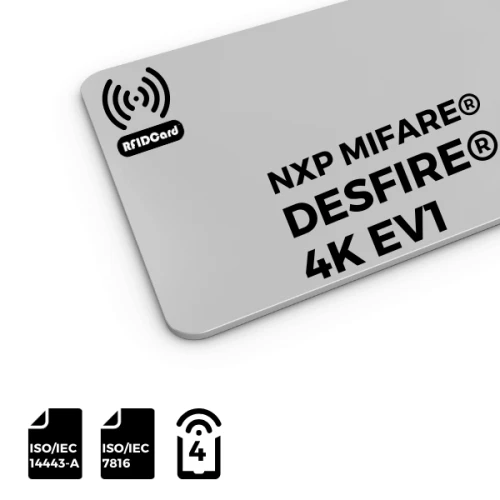
RFID Card CR80 MIFARE® DESFire® EV1 4K

The MIFARE® DESFire® EV1 4K RFID card is a secure, high-capacity contactless smart card ideal for various applications like access control, transportation, and payment systems. It features 4KB of integrated memory, advanced encryption standards for security, and is compatible with existing MIFARE® systems.