


As Near Field Communication continues to shape how consumers interact with products, services, and devices, two core tag formats dominate the conversation: NFC Forum Type 2 and NFC Forum Type 4. Whether you are a brand planning a retail campaign, an engineering team developing access control systems, or a smart packaging designer looking for cost-efficient NFC, choosing the right NFC card or tag type matters. NFC Forum Type 2 is often seen as the entry-level standard—low cost, widely compatible, and ideal for high-volume deployment—while Type 4 is treated as the secure, premium option for payment, access, and identification systems. Understanding the difference between these two formats helps companies make informed, strategic decisions.
1. What Is NFC Forum Type 2

The NFC Forum Type 2 specification is the workhorse of the NFC world, prized for its simplicity, low cost, and broad compatibility. It is the go-to choice for mass-market applications where the primary function is to deliver a small payload of data quickly and efficiently.
1.1 Technical Definition
NFC Forum Type 2 tags are defined by the NFC Forum and typically follow the ISO/IEC 14443-A communication standard. Type 2 tags are simple, low-power, cost-optimized NFC devices with relatively small memory sizes. They use a simple command set and support NDEF (NFC Data Exchange Format), which means smartphones can easily read data like URLs, text, vCards, and application triggers.
The chips that comply with this specification are typically derived from the NXP MIFARE Ultralight family, with the NTAG series being the most common and widely adopted chip families today. These chips are designed for minimal complexity and maximum efficiency in simple read/write operations.
1.2 Key Features
The core features of NFC Forum Type 2 include:
Compatibility with nearly all NFC-enabled smartphones
Low power consumption
Password protection and lock bits for basic security
Simple memory structure
Typical data rate of 106 kbps
1.3 Typical Use Cases
The characteristics of NFC Forum Type 2 cards make them ideal for applications that prioritize low cost, high volume, and simple data delivery:
- Smart Packaging and Product Authentication: Embedding Type 2 cards into product packaging allows consumers to tap their phone for product information, authenticity verification, or promotional content.
- Review and Feedback Cards: Restaurants and businesses use Type 2 cards on tables or counters to instantly direct customers to an online review page or feedback form.
- Loyalty Programs and Marketing: Simple “tap-to-join” or “tap-to-redeem” loyalty programs, where the card simply launches a web page or a specific app function.
- Low-Cost Mass Deployments: Due to their inexpensive nature, they are perfect for large-scale deployments like smart posters, museum exhibits, or event wristbands where the cost per unit must be minimal.
2. What Is NFC Forum Type 4
In stark contrast to its Type 2 counterpart, the NFC Forum Type 4 specification is designed for applications that demand high security, larger data storage, and the ability to support multiple applications on a single tag. It is the specification of choice for secure, high-value transactions and identification.

2.1 Technical Definition
NFC Forum Type 4 tags follow the ISO/IEC 14443-A or 14443-B standards and can communicate at higher speeds. They use a file-based system rather than simple pages of memory. Type 4 tags support larger memory sizes, enabling complex data structures such as multiple NDEF records, encrypted files, and application data. Unlike NFC Forum Type 2, Type 4 can support multiple applications running on the same tag, which makes it ideal for use cases where security and authentication are essential.
2.2 Key Features
The defining features of Type 4 tags include:
- Advanced security features, including AES encryption
- High memory sizes, often up to tens of kilobytes
- Fast data transfer up to 424 kbps
- Multi-application support
- File-based data management
2.3 Typical Use Cases
The robust security and performance of Type 4 tags are leveraged in mission-critical and high-security applications:
- Payment Systems: Contactless payment cards and mobile payment solutions (e.g., those using a Secure Element) rely on the security and file structure of Type 4 specifications.
- Access Control Cards: Corporate ID badges, hotel key cards, and physical access control systems that require secure, authenticated entry.
- Government ID and e-Passports: National identity cards and electronic passports use Type 4-compliant chips to securely store biometric and personal data.
- Transport Ticketing: Advanced public transport systems, such as London’s Oyster card or similar systems, use Type 4 tags for secure, fast, and reliable fare collection.
3. Detailed Comparison: Type 2 vs Type 4
The distinction between NFC Forum Type 2 and Type 4 can be summarized across four key technical dimensions, which ultimately determine their suitability for different market segments.
| Feature | NFC Forum Type 2 | NFC Forum Type 4 |
| ISO/IEC Standard | ISO/IEC 14443 Type A | ISO/IEC 14443 Type A or B |
| Communication | Proprietary commands | APDU commands |
| Data Rate (Max) | 106 kbps | 424 kbps |
| Memory Capacity | 48 bytes to 2 KB | 4 KB to 32 KB+ |
| Security | Basic password protection | Secure Element, AES, Access Control |
| Cost | Low | High |
| Use Case Focus | Marketing, simple data, low-cost | Payment, ID, secure access |
4. Choosing Between Type 2 and Type 4
The decision between NFC Forum Type 2 and Type 4 is not about which is “better,” but which is right for the specific application. It is a classic trade-off between cost, simplicity, and security/performance.

4.1 Decision Factors
Several factors must be weighed when selecting the appropriate tag:
- Application Scenario: Is the goal simple consumer interaction or a secure transaction? Simple interactions point to Type 2, while secure transactions necessitate Type 4.
- Security Needs: Does the data on the tag need to be protected from reading or cloning? If the data is sensitive (e.g., financial, personal ID), the advanced security of Type 4 is non-negotiable. If the data is public (e.g., a website URL), Type 2 is sufficient.
- Budget Constraints: Type 2 tags are significantly cheaper than Type 4 tags. For deployments involving millions of units (e.g., product packaging), the cost difference is a major factor.
- Data Capacity Requirements: Does the tag need to store a large amount of data or support multiple, isolated applications? If the requirement exceeds the 2 KB limit of Type 2, or if a file system is needed, Type 4 is the only option.
4.2 Quick Recommendation Matrix
The following matrix provides a quick guide based on common application requirements:
| Application Requirement | Recommended Tag Type | Rationale |
| Marketing & Consumer Engagement | Type 2 | Low cost, simple NDEF payload (URL), high volume. |
| Product Authentication (Basic) | Type 2 | Simple unique ID (UID) check, low-cost implementation. |
| Secure Authentication & Access Control | Type 4 | Requires high-level security, AES encryption, and access control features. |
| Contactless Payment & Ticketing | Type 4 | Demands high speed, large memory, and a Secure Element for financial data. |
| Simple Data Storage (e.g., Business Card) | Type 2 | Small data size, no security required beyond basic write protection. |
| Multi-Application Cards | Type 4 | File system architecture required to host and isolate multiple applications. |
5. Case Studies
Examining real-world deployments illustrates the distinct roles of these two tag types.
5.1 Type 2 Example: Kraft Heinz Consumer Engagement
In a landmark case study, Kraft Heinz utilized NFC tags embedded in the packaging of their “Kraft Singles” cheese product, sold at major retailers like Walmart. The goal was to drive consumer engagement and provide a digital experience at the point of sale.
The tags used in this deployment were almost certainly NFC Forum Type 2 compliant (such as NTAG chips). The application required a low-cost, high-volume solution where each tag simply needed to store a unique URL. When a consumer tapped their smartphone to the package, the tag transmitted the URL, which directed them to a promotional website, a recipe, or a chance to win a prize. The simplicity of the Type 2 tag was perfectly matched to the application’s requirements.
5.2 Type 4 Example: London Transportation Ticketing

The London public transport system, managed by Transport for London (TfL), is a prime example of a high-security, high-performance NFC deployment. While the original Oyster card used a proprietary technology, modern contactless payment for transit in London relies on the global EMV standard, which is implemented using technology that aligns closely with the capabilities of the NFC Forum Type 4 specification.
The system requires:
- High Speed: Transactions must be completed in milliseconds to avoid delays at turnstiles.
- High Security: Financial data (contactless bank cards) and stored value (Oyster) must be protected with robust encryption and authentication.
- Complex Data Management: The system needs to manage transaction logs, fare calculations, and security keys.
These requirements necessitate the file system, high-speed communication, and secure element features inherent in Type 4-compliant chips. The use of Type 4-like technology ensures that the ticketing process is not only fast and convenient but also meets the stringent security standards required for financial transactions and critical infrastructure.
6. Conclusion
Choosing between NFC Forum Type 2 and NFC Forum Type 4 depends on your business goals. NFC Forum Type 2 is ideal when affordability, simplicity, and scalability matter most—especially in retail marketing, product authentication, and loyalty applications. Meanwhile, Type 4 offers high-end security, faster performance, and the ability to run multiple applications, which makes it a natural choice for banks, governments, transportation systems, and enterprise access control. Ready to integrate NFC into your products? Our team can help you choose the right NFC card type for your application—from cost-efficient NFC Forum Type 2 cards to secure Type 4 solutions. Contact our team for a free consultation today.
FAQs
1. What is NFC Forum Type 2 used for?
NFC Forum Type 2 tags are primarily used for simple, high-volume applications such as smart posters, product packaging, loyalty programs, and business cards. They are ideal for delivering a small, non-sensitive data payload, typically a URL or a short text message, to a smartphone. Their low cost and broad compatibility make them the standard for consumer engagement and marketing campaigns.
2. Does iPhone support NFC Forum Type 2?
Yes, modern iPhones (iPhone 7 and later) fully support reading NFC Forum Type 2 tags, provided the tag contains a valid NFC Data Exchange Format (NDEF) message. Since iOS 11, Apple has enabled native reading of NDEF tags, allowing users to tap a tag to trigger an action (like opening a website) without needing a third-party app.
3. How much data can a Type 2 tag hold?
NFC Forum Type 2 tags typically hold between 48 bytes and 2 KB of data. The most common chips, such as the NTAG213, offer 144 bytes of user memory, which is enough to store a standard-length URL or a vCard. The maximum capacity of 2 KB (found in chips like the NTAG216) is sufficient for most simple consumer applications.
Recommended Product
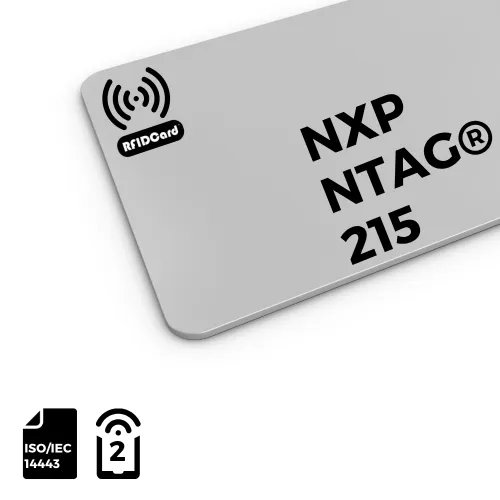
NFC Card NXP NTAG® 215 NFC Type 2

The NTAG® 215 RFID card is made with Photo quality standard PVC sheets into size of CR80, it programmed 7-byte UID with 504 bytes of user memory available (126 pages). The NTAG® 215 NFC ICs fully comply to NFC Forum Type 2 Tag and ISO/IEC14443 Type A specifications.

NXP NTAG® 424 DNA NFC Type 4 Card | ISO14443-A CR80
Unlock advanced security with our NTAG® 424 DNA CR80 RFID Card. Compliant with ISO/IEC14443 Type-A and NFC Forum Type 4, it features AES-128 encryption and SUN authentication for secure NFC messaging. Compatible with Android and iOS11+, and ideal for secure NFC and IoT applications like cryptocurrency wallets and NFTs. Made from photo-quality PVC or other materials in CR80 size.
Note: Cards are supplied in factory-default condition, with no data pre-encoded. For pre-encoding to enable immediate verification, please contact us for pricing.


