


It is common to find that printed PVC cards do not perfectly match the original design on screen. This is not always a printing defect, but a result of differences between digital design, printing systems, and material characteristics.
PVC cards are widely used for hotel key cards, membership cards, and ID cards, where color consistency is important for brand image. However, several technical factors can affect the final printed result.
In this article, we will explain why these color differences happen and how they can be minimized in professional PVC card printing.
Inherent Reasons for Color Differences in PVC Card Printing
Color differences in PVC card printing are not random—they come from a combination of digital display systems, printing technology, and material behavior. Understanding these core factors helps set realistic expectations and improves the accuracy of your final printed results.
A. RGB vs. CMYK: The Fundamental Disparity
One of the most important reasons for color variation is the difference between RGB and CMYK color systems.
RGB (Red, Green, Blue) is used for digital screens such as monitors, laptops, and phones. These devices create color by emitting light, which means colors often appear brighter and more vibrant on screen.
In contrast, CMYK (Cyan, Magenta, Yellow, Black) is used in printing. Instead of emitting light, printing relies on ink that absorbs and reflects light on a physical surface. Because of this fundamental difference, certain bright or neon-like RGB colors cannot be perfectly reproduced in CMYK printing.
This means that a color you see on your screen will always be an approximation of the final printed result. RGB to CMYK conversion is one of the main causes of perceived color shifts in PVC card production.

B. Display Variations: The Unreliable Digital Canvas
Another often overlooked factor is the variation between different digital displays.
Even if two people are viewing the same design file, the colors may appear slightly different depending on the monitor they use. Factors such as brightness settings, color temperature, contrast, and factory calibration all affect how colors are displayed.
For example, a design that looks perfectly balanced on a high-end calibrated monitor may appear darker or more saturated on a standard laptop or mobile screen. This makes digital screens an inconsistent reference for print production.
As a result, relying solely on on-screen colors during the design stage can lead to unexpected differences once the PVC cards are physically printed.
C. PVC Material Characteristics: The Substrate’s Influence
Beyond color systems and screens, the physical properties of PVC material also play a significant role in the final appearance of printed colors.
PVC cards are available in different surface finishes such as glossy, matte, frosted, or textured. Each surface interacts with ink differently. For example, glossy PVC surfaces tend to reflect more light, making colors appear more vivid and saturated. Matte finishes, on the other hand, absorb more light and often produce a softer, more muted color effect.
In addition, the natural base tone and smoothness of the PVC material can slightly influence how ink is absorbed and layered on the surface. Even small variations in material coating or texture can result in noticeable differences in perceived color.
This is why the same design may look slightly different when printed on different types of PVC cards, even under the same printing conditions.
5 Ways We Improve PVC Card Color Accuracy in Our Production
While color differences in PVC card printing cannot be completely eliminated, they can be significantly reduced through proper design preparation and professional production control. At our factory, we apply the following methods to ensure high color consistency between your design and the final printed PVC cards.
1. Design in CMYK from the Outset
To achieve more accurate printing results, we recommend and support CMYK-based file preparation from the beginning of the production process.
Although RGB files are widely used in digital design, they are not suitable for print production. In our workflow, RGB files will be converted into CMYK during pre-press processing, which may cause slight color shifts. To minimize this, we always encourage clients to design directly in CMYK to reduce conversion-related differences and improve predictability.
2. Ensure High-Resolution Image Assets
We always advise clients to use high-resolution image files to ensure the best printing outcome on PVC cards.
For bitmap images such as photos, we recommend a minimum of 300 DPI. This ensures that details remain sharp and clear during production. For logos and graphic elements, vector files are strongly preferred, as they allow us to maintain perfect edge sharpness regardless of size.
In our production process, we carefully check all submitted files to ensure they meet print quality standards before moving to the next stage.
3. Leverage Our Professional Pre-Press Processing
Before printing begins, our in-house pre-press team performs detailed file optimization to prepare your artwork for PVC card production.
This includes color profile checks, layout verification, and print compatibility adjustments. Importantly, we do not arbitrarily change your design colors. Instead, we make controlled technical adjustments to ensure your design can be accurately reproduced on PVC material under real production conditions.
This step is critical in reducing unexpected color shifts during mass production.

4. Rely on Our Experienced Color Management Team
Our PVC card printing process is supported by experienced technicians with over 10 years of hands-on color management expertise.
During production, our printing specialists continuously monitor ink balance, machine status, and color output consistency. They compare live samples with approved design files and make fine adjustments when necessary.
This combination of digital control and manual fine-tuning allows us to maintain stable and consistent color performance across different PVC card batches.
5. Proofing & Color Matching Service for Critical Projects
For projects where brand color accuracy is extremely important, we strongly recommend our physical proofing and color matching service.
We provide printed samples or match against physical color swatches (including Pantone references when required) before mass production. This allows both our team and the client to confirm color accuracy under real PVC printing conditions. Understanding the difference between spot color and CMYK printing can help improve color consistency.
Through this process, we can achieve significantly improved color consistency and reduce the risk of visual deviation in the final product.
Conclusion: Partnering for Precision in PVC Card Printing
While color differences in PVC card printing are unavoidable due to the nature of digital design, printing systems, and material characteristics, they can be significantly reduced with the right approach. By making informed design decisions and working with a professional printing partner, clients can achieve far more stable and predictable color results.
At our factory, we combine advanced printing technology with experienced craftsmanship to ensure high color accuracy for every PVC card project. From strict pre-press file checking to hands-on color adjustment during production, every step is carefully controlled to closely match your original design intent.
Whether you are producing hotel key cards, membership cards, or corporate ID cards, our goal is to deliver consistent, high-quality results that reflect your brand accurately.
If you are planning your next custom PVC card project, feel free to contact our team. Our experts can review your artwork, recommend the best production approach, and help you achieve the highest possible color consistency for your cards.
Frequently Asked Questions (FAQs)
1. Can I use an RGB file for PVC card printing?
Yes, RGB files can be submitted. However, they will be converted to CMYK during the printing process. To reduce unexpected color shifts, we strongly recommend designing your files directly in CMYK from the beginning.
2. What is the ideal resolution for images on PVC cards?
For bitmap images such as photos, we recommend a minimum resolution of 300 DPI (dots per inch) to ensure sharp and clear printing results. Vector graphics such as logos and text are resolution-independent and will always print cleanly regardless of size.
3. Does the type of PVC material affect the final color?
Yes. The surface finish of PVC cards has a significant impact on color appearance. Glossy surfaces tend to enhance brightness and saturation, while matte or frosted finishes usually create a softer and more muted look. We can help you choose the most suitable material based on your desired color effect.
4. How can I ensure my brand colors are accurately matched?
For critical brand color requirements, we recommend providing a physical color swatch (such as Pantone references) or approving a printed proof before mass production. This allows our team to match colors more precisely and achieve higher consistency in the final output.
5. Is it possible to completely eliminate color differences in PVC card printing?
Due to the fundamental differences between RGB digital displays and CMYK printing systems, it is not possible to eliminate color differences completely. However, with proper file preparation, material selection, and professional production control, these differences can be minimized to a very high level of accuracy.
Recommended Products
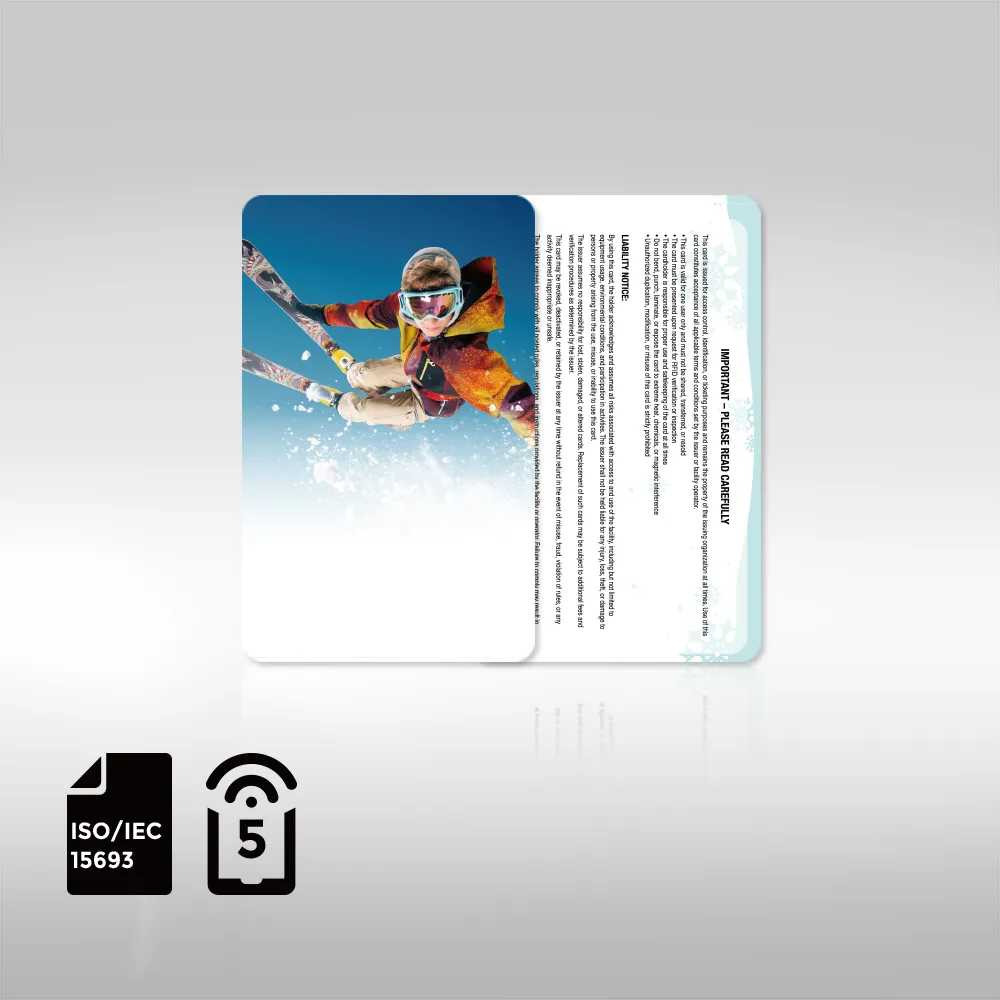
RFID Ski Pass Card NXP ICODE® SLIX2

The NXP ICODE® SLIX2 RFID Ski Pass Card is a high-performance HF smart card designed for ski resorts, mountain attractions, and outdoor access applications. Embedded with the NXP ICODE® SLIX2 chip, this card operates at 13.56 MHz and complies with ISO/IEC 15693 and NFC Forum Type 5 standards, providing reliable contactless identification and fast access validation. With long read range capability, anti-collision support, and sufficient user memory, it is suitable for lift access control, season passes, guest identification, and resort ticketing systems.



